
Return Me to Yahoos
On ".44" by Jimmy Breslin and Dick Schaap, and "Off the Wall" by Charles Willeford

I. The Chubby Behemoth
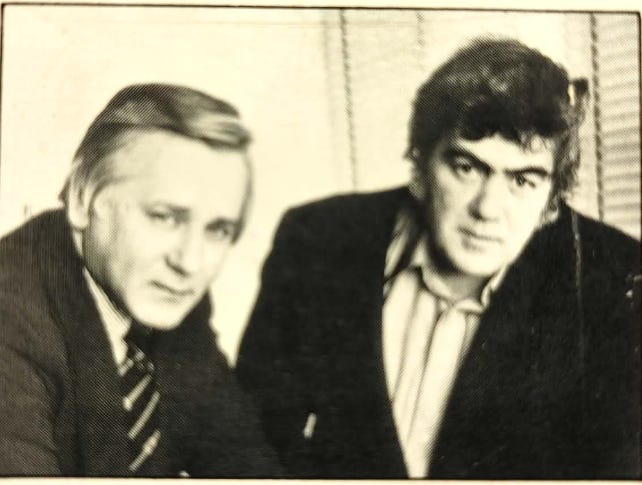
Author Read Before: Jimmy Breslin
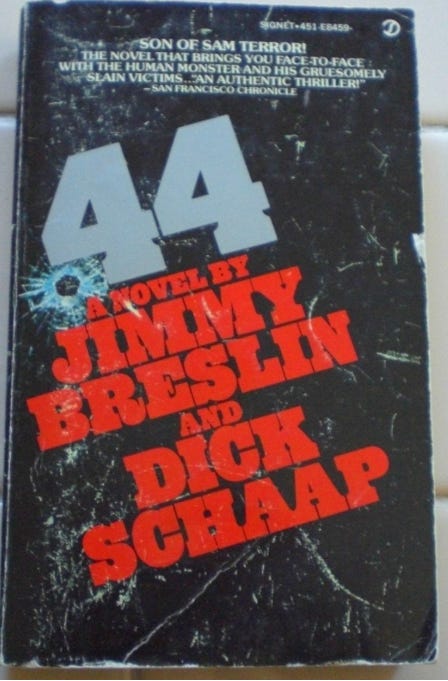
Books Previously Read: The Gang that Couldn’t Shoot Straight; I Don’t Want to Go to Jail
Author Never Read: Dick Schaap
Book Read: .44
There’s a good bit of acting, and/or directing of an actor, in Spike Lee’s Summer of Sam. It’s a small moment, and I just noticed it for the first time when rewatching the film about a week ago. Anthony LaPaglia and Roger Guenveur Smith, as two homicide detectives working the Son of Sam case, are sitting down at a table in a restaurant with a top mafioso, played by Ben Gazzara, and some of his men. They are there to ask for the mafia’s help, in getting information within the Italian community, if anybody knows anything about the murders. The meeting is heated, what with Smith being black and the mob guys being racist, plus the fact that LaPaglia’s character and Gazzara’s character go back to the cop’s childhood. So, initially, the detectives’ request for help is rebuffed. So LaPaglia takes out a letter. Gazzara keeps eating, eyes on his plate. The letter is one left by David Berkowitz, the Son of Sam, at the site of one of the shootings. Gazzara keeps eating, eyes on his plate, completely indifferent, until LaPaglia reads the words “I am the Son of Sam.” At those last three words, Gazzara’s head suddenly turns towards the letter in LaPaglia’s hand, with an expression on his fact that precisely and silently communicates the message “What the fuck?” Because that, I think, is at the core of why those serial murders, just one set of such killings in America out of hundreds, possibly thousands, continue to fascinate. When you first encounter a reference to the Son of Sam, you don’t immediately know the context of that name, why it was chosen. And on its face, there’s nothing sinister about it, but since we know it was self-applied by a serial killer, its very surface benignity makes it exponentially more frightening. (I touch on this phenomena, and I don’t think that’s too grandiose a term, a little bit in my piece on John Darnielle’s Wolf in White Van.)“What blisteringly fevered and maggoty train of thought could have led to those words, and what depraved meaning could it have for the man who calls himself that?” Of course, once you know the context for the name, you realize just how depraved the meaning actually was, no speculation needed on our end. But before that, you speculate, and your very inability to land on an explanation that even makes any kind of lunatic sense — actual lunacy being blessedly outside our grasp — just makes it worse. It becomes almost cosmically frightening.
As I probably don’t need to tell you, between Christmas Eve, 1975, and July 31 1977, a serial killer who dubbed himself the Son of Sam, real name David Berkowitz, terrified New York City in a series of late night shootings, killing six and wounding another eleven. Most of the attacks were against young men and women sitting in cars at night. Early attacks occurred largely in or around Queens, though as the case gained notoriety, Berkowitz began to branch out to other boroughs. The murder of Donna Lauria on July 29, 1976, was the crime that allowed the police and journalists to start noticing similarities between that murder and earlier crimes. It was when Lauria was murdered that the realization dawned that there was a madman on the loose. So flamboyant a madman that he would join the ranks of serial killers like Jack the Ripper and the Zodiac in writing berserk and rambling letters to the police and the press (yes, Jack the Ripper probably didn’t actually write any of them, I know). The first letter, left at the scene of the double murder of Alexander Esau and Valentina Suriani, was addressed to Joseph Barelli, the homicide detective heading the investigation. His subsequent letter to New York Daily News columnist Jimmy Breslin, in which Berkowitz, among other things, complained about those doctors in the press who would deign to psychoanalyze him, and accuse him of hating women, which he vehemently denied even though it’s clearly true. The primary victims in almost all of the shootings were young, attractive women with long brown hair. If their boyfriends were in the seat next to them, he’d kill them too, so be it. His reasons, he claimed in his letters, were that he was merely following orders, communicated to him by his neighbor’s dog, Harvey. The orders originated from Harvey’s owner, a man named Sam Carr, whom Berkowitz believed was a demon who controlled him and would punish him severely, if Berkowitz did not murder people, thereby providing Sam with blood to drink. This subservient role that Berkowitz imagined for himself makes him, in essence, the Son of Sam.
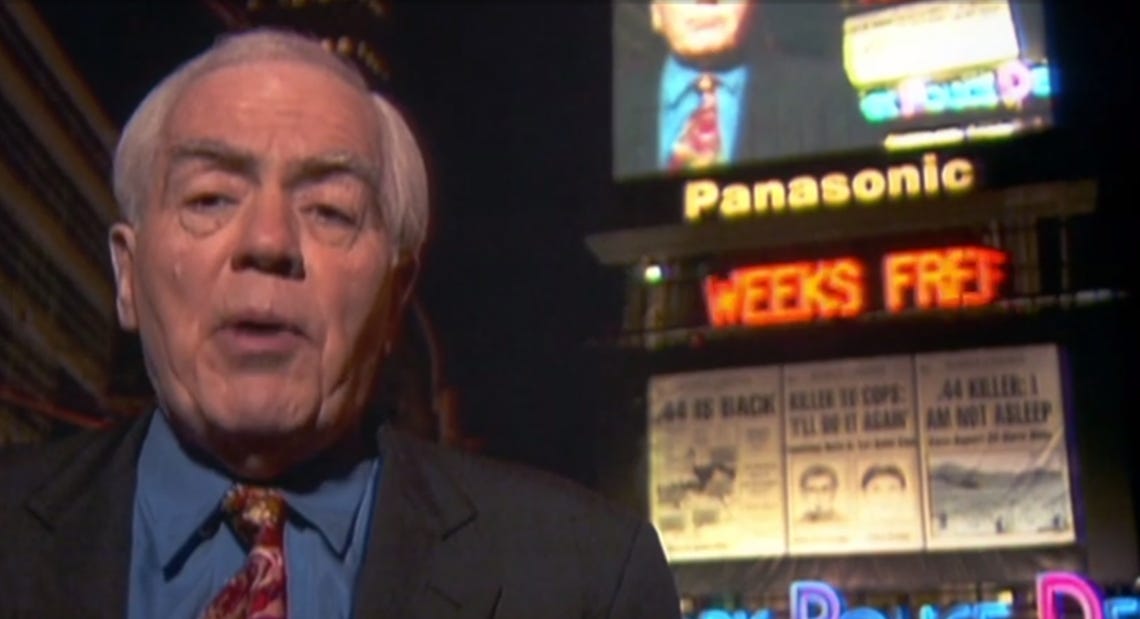
This was national news, so it’s not surprising that anyone with a relevant story to tell might try to turn the telling of that story into a payday. The most famous person to do so was the aforementioned Jimmy Breslin, columnist for the New York Daily News. Breslin was also a prominent crime reporter, with many contacts both within and outside of law enforcement. Though Breslin enjoyed his own share of politically incorrect controversies, especially as he got older, he was a tireless chronicler of the stresses and injustices and hardships in life as lived by regular people. In 1986, he won the Pulitzer Prize for Commentary, with “for columns which consistently champion ordinary citizens" cited as the reason.
Breslin bragged that he told the truth in his columns, whether the truth reflected well on, or was agreed to be the truth by, all of his readers. As a result, reading .44 in 2026, a time when art, and especially literature, is routinely sanded down and self-congratulatory, can come as a bit of a jolt. That’s because in .44, published in 1978, just a year after Berkowitz was caught, and in an era when arguably exploitational airport novels might actually be quite well written, pretty much everyone is at least somewhat racist, and not just white racism targeting black people, although that is sort of ever-present. Though, ironically:
Blacks were the only ones who got off easy. For the first time in the lives of some of them, they were above suspicion. They had, in the context of this terrible fear that swept through the city, turned white. They could sit or stand on a subway and not catch a suspicious or hateful glance.
I see the point, but that last bit is probably arguable. Anyway, most of the racism is aimed by Italians at the Irish, and vice versa, much of which is communicated through the relationship between Inspector Carillo, Breslin and Schaap’s fictional version of Barelli, and Danny Cahill, columnist for the New York Dispatch, and Breslin and Schaap’s fictional version of Breslin. No one, as you may have gathered, travels under their own name here, and that includes David Berkowitz, who here is Bernard Rosenfeld (however, and with the times when Berkowitz mentioned someone by name being the exceptions, the Son of Sam letters are quoted exactly as they were actually written).
Carillo rose to Inspector by virtue of how good he was at his job, and his strong political savvy, which left all of his Irish superiors to begrudgingly promote him to that position, because it would look weird if they didn’t. He also believes that all Irish cops are stupid, and that all the mistakes made early at the crime scene of the Son of Sam attack that opens the novel, in which a young woman named Connie Bonventre is killed and her friend wounded, are attributable to that fact. Carillo is a stickler for proper procedure, because it’s in the early moments that the most information can be gained and lost. This includes his intense regret that no cop was present at the hospital to question Connie Bonventre about who had shot her in the head, before she died. This attitude of Carillo’s comes off as callous, but is probably also absolutely correct and necessary.
As for Cahill, he’s less racially-minded than Carillo, but Breslin and/or(?) Schaap aren’t shy about showing his flaws. In addition to being arrogant, he worries he’s not good enough. He seeks fame, and when the Bonventre shooting news pushes his column further into the paper’s back pages, he complains that nobody cares that some girl got shot. He also feels a sick pride at being recognized by the Son of Sam, and to be referred to by the killer as “Danny” (Carillo has a similar reaction following the arrest). Furthermore, after distracting his own bleak thoughts by making a friend he was speaking to over the phone feel even worse:
Cahill hung up elated. He had driven truth from his mind, always a victory, and replaced it with that warm feeling which comes with doing well at another’s expense. If somebody were to do this to Cahill, if somebody were to start the day by telling Cahill that he has too much love of seeing others fail to be a good fellow, Cahill would require medication. Take it, he could not.
Well, Breslin was always going on about how he told the truth. This seems like evidence of him putting his money where his mouth is. Or pretending to. Who knows. (For the record, Cahill shares Breslin’s genuine admiration for Berkowitz’s prose style.)
One of the features of a book like this, by the way, these sorts of books being much more leisurely paced than they are now, is you get odd bits, like in this there’s a digression at one point about the police sketch artist, mentioned earlier, behind those laughably inaccurate suspect sketches of Son of Sam. If you’ve ever seen those sketches, and seen David Berkowitz, you might guess why Breslin and/or Schaap (though I’m betting Breslin) might wish to make that detour. You also get intense investigations into suspects who, finally, seem like they could be the guy, but which we, the readers, know are just more blind alleys. We’re in the head of Rosenfeld/Berkowitz as often and as early as we are in the heads of Carillo or Cahill or the victims.
At ten o’clock, he drove home to Hudson Terrace. The rain would protect him from the dogs for the rest of the day. He made a ravioli TV dinner and he watched game shows on television. He began thinking of Connie Bonventre again. He wondered why he never had felt anything after he had killed her. Then he thought of the others. He felt nothing about them, either. Well, you just shot them and that’s what you did, he told himself. He felt more satisfied than sad. This is what they have done to me, he told himself. They have taken away all my feelings. They have turned me into a soldier. A soldier can’t stop after each time he shoots someone. He can’t be going around a battlefield and weeping. He shrugged and watched the television.
There is much entertainment to be found in .44. It’s funny and satirical at times, especially when Breslin (again, one presumes) vents his spleen over his utter disdain for TV news “reporters” and anchors, or his disgust with the cynical, dishonest journalism to be found in the New York Post stand-in, and owned by a Rupert Murdoch stand-in, called the Express. The Daily News and the Post were rivals for years, and never more so than during the Son of Sam killings. Predatory pseudo-psychoanalysts spewing baseline Freudian nonsense on TV are also treated mercilessly.
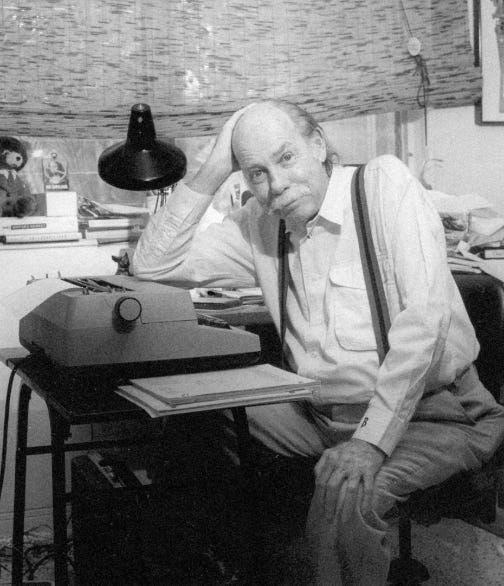
There’s also some unintentional humor to be found any time Breslin and Schaap (pictured at the top) venture into the world of 1970s New York City discotheques. Breslin was a big enough name that I’m sure he was invited to some events held in such places, but the novel never quite feels at home in those scenes.
But it’s also a novel not lacking in despair, and the futility of fighting against a tide of people like Berkowitz:
The tips, the suggestions poured in in incredible numbers — and incredible detail. If one out of every ten calls could be believed — and nine out of ten rang true — then the City of New York contains dozens of hundreds, perhaps thousands, of potential mass murderers. That was the scary part. Only one bomb had gone off in one head, and already five young people were dead because of it, but anybody working on the case knew that there were dozens of similar bombs, ticking inside similar heads, each one capable of exploding momentarily or never. Pablo Birani [one of the novel’s prime suspects before suspicion turns to Berkowitz - Ed.] was not the .44-caliber killer, but he could have been. Pablo Birani could kill. He could kill without motive, without reason. He had a good mind; he was an intelligent man. It was just that his wires were crossed.
Still, it’s a very strange book. Why does it exist in this form? Why didn’t Breslin write a non-fiction account of his experience? Why bring Dick Schaap in, a sports reporter who, at the time, didn’t even work on the same paper as Breslin? On its surface, .44 feels somewhat tacky. Especially in the opening scene, where Connie Bonventre is getting ready for a night out — the prose lingers on both her youth and her anatomy more than I would say is seemly, under the circumstances, although Breslin and Schaap do not push this very far, and this sort of writing does not reoccur elsewhere in the novel. One could excuse it as the authors wanting to suggest there was probably a sexual component to Berkowitz’s crimes, without laying it on too thick. Then again, there are some awfully hair-rising dirty jokes, for lack of a less juvenile phrase, scattered throughout .44. But those never apply to the victims, or their fictional stand-ins, of Son of Sam.
But Breslin had to have approached this with some inwardly directed cynicism. In his July 28, 1977 column — published the day before the one year anniversary of Donna Lauria’s murder — Breslin discusses the letter the Son of Sam sent him, which ends “Remember Ms. Lauria. Thank you.” In the piece, Breslin admits:
What do I have for the 29th? I have this, a column about the .44 killer and his victims, particularly the first victim, Donna Lauria. Which is exactly what the killer wanted when he sent me the letter. He who would be God with the lives of young women can also use his great power to direct the newspapers to write what he wants and when he wants it.
.44 was perhaps Breslin’s way of getting some of that control back, to feel less used. I don’t know. I also don’t know why Schaap was involved. That they’d once worked together at the Herald Tribune doesn’t seem to cover it, and Richard Esposito’s biography Jimmy Breslin: The Man Who Told the Truth is exasperatingly silent on the process of writing the novel.
But it’s a serious novel, and a compassionate one (though in .44 Breslin writes less about the families of the victims than he did in his columns). It’s a novel that wonders how such a thing can even happen, how people can become these things, creatures who kill and maim remorselessly. It’s a novel that, when you strip away some of its NYC bombast and cynical bluster, worries about what we’ve done to ourselves, and how far into the future we’ll be paying for it.
II. Sam the Terrible
Author Read Before: Charles Willeford
Books Previously Read: Made in Miami; High Priest of California; Wild Wives; Pick-Up; The Woman Chaser; The Black Mass of Brother Springer; Understudy for Death; The Difference; Cockfighter; The Burnt-Orange Heresy; Miami Blues; Grimhaven; New Hope for the Dead; Sideswipe; The Way We Die Now; The Shark-Infested Custard; about half the stories in The Machine in Ward Eleven
Book Read: Off the Wall
Craig Glassman, the volunteer deputy sheriff and nursing student, who lived in the apartment below Berkowitz in Yonkers, was also targeted for harassment, if that’s the word, by the serial killer. Glassman received letters from Berkowitz, though for a while he didn’t know who was sending them, nor did he immediately connect them to the Son of Sam letters, received by Breslin and Barelli, that were all over the news. But for reasons known only to him, Berkowitz’s belief that demons were ordering him to commit murder expanded to include Glassman. So, the recently divorced volunteer deputy sheriff found himself receiving letters that said things like: “So, Craig, in your honor, I present you with many corpses so that you should have plenty of meat in the off-season.”
It would take too long to lay out all the connections that Glassman, and other cops, finally made that linked Berkowitz to the Son of Sam murders, but in Glassman’s specific case, they included, once his suspicions had been raised, seeing a rifle in the back seat of Berkowitz’s car, and in the passenger seat a handwritten letter that at a glance appeared to resemble the handwriting of the Breslin and Barelli letters, and the one’s Glassman had received. For a variety of reasons, including the scope of the police manhunt for the killer making it very difficult for all participating precincts, which means pretty much all NYC police precincts, and eventually Yonkers as well, to keep straight who was following what leads, and the investigative focus pointing elsewhere — did anyone really think the Son of Sam was in Yonkers? — it was difficult for cops who had similar feelings about Berkowitz as Glassman to get a warrant. Eventually everything fell into place, and the divorced volunteer deputy was in on Berkowitz’s arrest.
Yet Glassman has curiously been phased out of most of the various fictionalized recountings of the murders committed by, and the investigation that led to the capture of, David Berkowitz. Glassman is nowhere to be found in Summer of Sam, for example. Most unusually, in .44, Breslin and Schaap split the Glassman figure into two separate entities. The cop who sees the rifle in Berkowitz’s car is unnamed, and is not sketched out in any way to resemble Glassman. More tellingly, Bernard Rosenfeld’s downstairs neighbor is named Mort. Of course, everyone’s names are changed in .44, and since “Mort” means “death” in Latin, Berkowtiz’s actual scribblings about Glassman — some of which were found written on his apartment walls when the police finally went in — make more sense if the name is Mort. Berkowitz wrote (and it’s right there on the book cover, see below) “Because Craig is Craig/So Must the Streets/Be Filled With Craig (Death),” which is nonsensical, but is slightly less so if the name is Mort, and you know what Mort means in Latin.
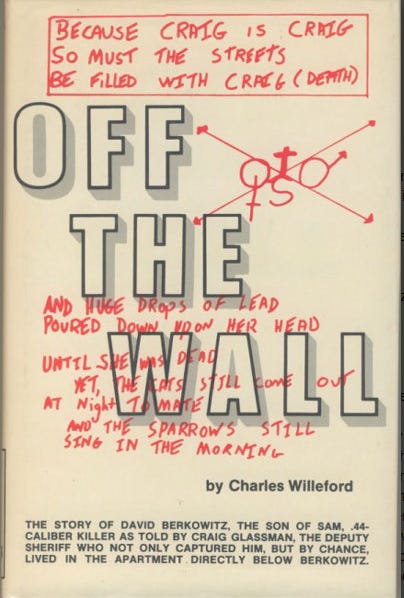
A likely reason for so many writers to have chosen to prune Glassman out of the narrative is the fact that in the immediate aftermath of the arrest, Glassman, according to his own daughter Shayna (who apparently is quite a pistol, and apparently subscribes to the “cult of serial killers” theory about Son of Sam (or at least some version of it; not surprisingly, Glassman’s 1991 death has been linked to this) went on a press tour. This is from an article in Westchester Magazine, written by Nathan Laliberte:
“My dad wanted Sylvester Stallone to play him in a movie, but the movie studios didn’t even want to look at it,” Craig says. “He was doing a publicity tour from the day the capture happened. He was writing letters to movie studios; he was all over the place doing radio and newspaper interviews.”After learning of Glassman’s intention to publish a book, New York City Police Detective Ed Zigo (who, along with Glassman and Detective Falotico, is credited with playing a major role in the Berkowitz arrest), dropped a snarky letter: “Hi Craig—remember me? I hear you’re writing a BUCK, I mean a book, about me and David. Be fair, Craig—I love you, too! (I’m famous also now—David sure did you and me a favor, didn’t he?)—Ed.” According to Shayna Craig, Detective Zigo—even decades later—refused to acknowledge the role Glassman had played in the Berkowitz arrest.
The book about Glassman—who died in a car accident in 1991—is titled Off the Wall and, due to a very limited print run, has become a collector’s item, currently selling for around $300 on Amazon. (One copy is priced at $750 because it is inscribed by Glassman.)
My copy of Off the Wall did not cost $750, or $300 for that matter, but check this out.
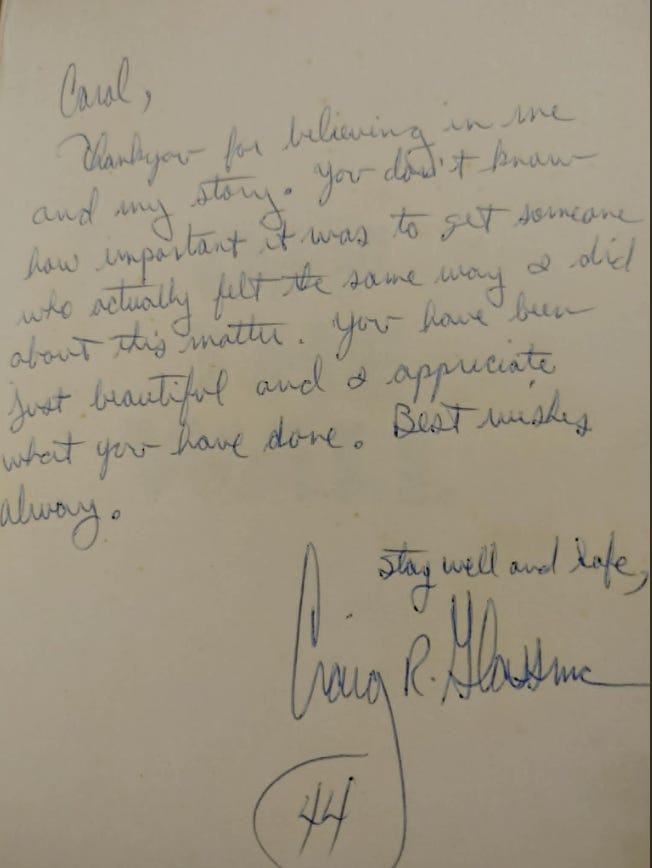
No dust jacket, but still. I had no idea it was there until the book arrived and I opened it. I’m not about to deny the role Glassman played in Berkowitz’s capture, but using “44” — as in .44 caliber, as in the .44 Caliber Killer — as part of your signature, even if only in this one context, strikes me as unsavory.
Despite what Ed Zigo said in his justifiably snarky letter, Glassman clearly was not the actual writer of the book, nor is it even a ghost writer type of situation. The writer was the great Charles Willeford, author of some of the great masterpieces in crime fiction, from the four-book Hoke Mosley detective series1, to the moral black holes of The Woman Chaser and The Burnt-Orange Heresy and The Difference (that one’s a Western), as well as one of the deepest gazes into the amoral void in all of crime fiction, the posthumously published The Shark-Infested Custard. Willeford went further and darker than almost any self-described hardboiled crime novelist, unless their name is Jim Thompson or James Ellroy.
All that being said, a true crime docu-novel (as some have awkwardly described Off the Wall), or, to use the probably more accurate Capote/Mailer term “non-fiction novel” was not something Willeford actively pursued. In Willeford, a book that is part biography, part bibliography, part extensive interview with its subject, and entirely index-free, writer Don Herron is frustratingly vague about how Off the Wall came to be, from Willeford’s perspective, saying only:
Willeford acknowledged that this book was hackwork when Signore [presumably an interviewer, though if so I’ve been unable to track down the interview - Ed.] asked him how he came to write it. He told told him that the publisher approached him with the idea, and the money was paid in advance. He liked the money in advance aspect. And that is why he wrote this book, for the same reason he forced himself to finish Lust is a Woman2, even though he knew it was terrible: money.
Off the Wall is not a terrible book, but it is a strange one. To begin with, it begins with a preface by Edna Buchanan, Pulitzer Prize-winning crime reporter for the Miami Herald (she would eventually turn to writing crime novels), in which she effusively praises Glassman and Willeford, and takes every possible opportunity to compare Berkowitz to Robert Frederick Carr III, a serial killer about whom Buchanan had coincidentally recently published a book. All of which indirectly points to another strange aspect of Off the Wall, which is that it is by necessity a New York City novel, but Willeford was a Florida crime novelist. Therefore, the kind of depth of geographical and neighborhood personality and detail that is all over Breslin and Schaap’s .44 is pretty much absent from Off the Wall.
In Don Herron’s book, in the long interview section, Willeford talks about the book’s authenticity:
CW: That Son of Sam, that’s about 90% factual. I just had to write a few things, to put in some bridges.
DH: You interviewed Craig Glassman?
CW: Yeah, I interviewed — all the the dialogue is authentic. It’s exactly what they said. I couldn’t change it, the detectives, because the guys’ names were there. You change what they say, they’ve got you on a suit, you know. They weren’t too happy about it anyway, because they didn’t like the idea of Craig getting all that credit, you know.
This is important for a few reasons. For one thing, just because someone says something in an interview, that doesn’t mean it accurately reflects their thoughts, words, or actions from three or four years before. So already, Off the Wall is shading into fiction. Further, having read the novel, the bridges Willeford talks about include a lot of situations where the reader is in the head of not only Glassman, but Berkowitz as well, and I do not believe, as much as I admire Willeford, that he could swear all those thoughts could be said to have authentically belonged to those men in those moments.
But of course, it is also through those bridges that Willeford is able to emerge as the writer he is. This is a small thing, but it had been a while since I’d read anything by Willeford, and I’d forgotten about some of his quirks, such as the obvious delight he took in describing in detail, but not exasperating detail, what his characters were eating. Throughout his bibliography, Willeford continuously takes a break from the narrative, whatever it might be, and decides “Well shit, this guy’s gotta eat something,” and so we’ll get a little story about lunch. I remember reading about the protagonist of his early novel High Priest of California ordering fried shrimp and French fries at a restaurant, and for weeks afterwards I was craving fried shrimp and French fries (and when I finally got them, I was a little disappointed). This happens a lot in Off the Wall, possibly because Willeford felt confined as a writer-for-hire, and wanted to put himself in there when- and wherever he could. I don’t know if it’s based on fact, though it wouldn’t surprise me, but in Off the Wall Willeford describes Berkowitz as having an almost cataclysmic sweet tooth, one that leads him to put Cool Whip in his tomato soup. Which is enough of a justification for a life term in prison, as far as I’m concerned.
Even as Herron criticizes Off the Wall, he acknowledges these moments as Willeford bringing himself into what must have seemed a very impersonal endeavor. In one early scene, one that Herron also highlights, the lonely, divorced Glassman invites two of his fellow nursing students — two attractive young women — back to his apartment to study, with no particularly lecherous motives (in Willeford’s telling anyway), and they decide to take a break:
Craig said it was time for a break, anyway, and he brought out a plateful of tuna salad sandwiches he had made on wheat bread, and a two-liter bottle of Tab. While they ate, Debbi asked Craig about the Betamax, and he gave the girls a demonstration.
“Do you have any dirty movies?” Sandi asked.
“No. Just Patton. Do you want to see Patton?”
Sandi shook her head, and Debbi giggled. “I was just teasing, Craig,” Sandi said.
They drink a lot of Tab in this book. And very little booze is drunk in either this or .44. Anyhow, perhaps the most curious thing about Off the Wall is the fact that it is a co-narrative, equally about Berkowitz as it is about Glassman. This, in a book that was apparently pitched by Glassman to boost his own profile. In another typical bit of Willeford-ian bridging, the author indulges in the kind of deflating of pomposity and pretension that he’s always been very sharp about, though in this case, the deflating — which involves the turning of an abstract painting upside down, to the notice of none of its ostensibly passionate admirers — is done by Berkowitz. Much is also made by Willeford of Berkowitz’s Born Again Christianity, but it’s such a muddle of diseased invention and a kind of twisted version of “you will see all your dead pets in heaven” innocence, that there’s not much you can do with it, as an explanation. Breslin and Schaap didn’t bother. Willeford also hammers on the sexual motivation behind the murders, which Breslin and Schaap, as I’ve said, only sort of glance at.
Another thing Willeford does that’s surprising, and I wonder what Glassman, thought of this, is he sort of equates the two men. Not in their actions or thoughts or anything like that, but both men are inflicted by a terrible loneliness. Glassman can’t understand why his marriage fell apart, is rebounding from a number of failed careers, and is trying to get himself back on some kind of right path. To keep himself from going mad with loneliness, he shares custody of his and his ex-wife’s dog and cat. The dog doesn’t endear Glassman to Berkowitz, and is only one of the many meaningless reasons why Berkowitz began to see Glassman as his new Sam Carr (that, and every time he left their building to go to work as an auxiliary sheriff’s deputy, Glassman was wearing a cop’s uniform), or his co-Sam Carr. He hated both men, but acknowledged both as his masters.
Yet, and this is perhaps unintentional on Willeford’s part, Glassman occasionally comes off as kind of a dope. For one thing, as laid out by Willeford, it’s unbelievable to me that Glassman didn’t make the connection between the letters he was receiving, the strange upstairs neighbor who yelled at him over the phone, with the Son of Sam killings sooner. They were national news by this point, so certainly citizens of Yonkers were as attuned to any Son of Sam updates as anyone was. And there’s a bit where Glassman is tearing his hair out about the contents of one of the letters, focusing on insults directed at his mother, which leads him to speculate on the game known as “the dozens,” which is a game popular in the black community that revolved around topping the other guy’s jokes about one’s mother. I find it absurd that he would make that leap, additionally believing that possibly some black radical political group was behind the letters, though he eventually dismisses this as being “decidedly unfair to blacks.”
Arguably worse is the bit near the end, at the arrest, when Glassman is not only in on the arrest, but he was the cop — among dozens who were there — who got to Berkowitz first, drew his gun and, Stallone-like, yelled “Freeze!” I’m sure that’s what Glassman told Willeford happened, but I don’t buy it. And then — and although in Herron’s book, Willeford makes it clear that he shares Glassman’s frustration that his suspicions weren’t taken more seriously early on (“They would have found the gun. They would have found all that stuff. They would have had him. They would have saved two lives.”) — after that, in a sort of epilogue that I can only imagine Willeford writing through gritted teeth (if indeed he, and not Glassman, wrote it), comes this:
Craig got his divorce from Mac without any difficulties, and his social life improved. In hardly any time at all, Craig had more women to choose from than he could handle, and he made out like a bandit.
As unpleasant as that is to read, imagine what writing it must have felt like.
You shouldn’t take any of this as an indication that Willeford displays any misguided sympathy, or even much empathy, for David Berkowitz. In one section, he writes that Berkowitz could not understand why anybody was making such a big deal about his murders:
Sometimes the stories in The New York Daily News were so far off base, he didn’t even save the clippings. What puzzled David the most when he read and re-read the news accounts of the shootings was the anger expressed by everyone concerned. The people he shot were all nobodies, nobodies just like himself. There hadn’t been a single important person in the lot; nor would any of them, if any had lived, ever have amounted to much of anything either. And yet, the way their friends and relatives talked, and carried on, at least the way the newspapers reported they talked, anyone who didn’t know any better would have thought that the loss of these nobodies was of great importance to the world. Not only were they non-entities, they were either foreigners or the children of foreigners. He could tell that by their un-American names.
Willeford knows full well that by laying out an inhumane, anti-human mindset this plainly, by depicting Berkowitz as a man so utterly remorseless that he can’t imagine anyone caring about these brutal, senseless murders, that, almost counterintuitively, the humanity of the victims rises up, or should do, in the reader’s mind as a kind of natural defense against such horror.
In his August 3, 1977 column for New York Daily News, Jimmy Breslin wrote about Jerry Moskowitz, the father of Stacy Moskowitz, who had just been murdered by Berkowitz. The column, which is called “Door Opens, It’s Always Stacy,” begins this way.
At night, Pat Violante, whose son lay practically blind from a .44 slug, came to the home of Jerry Moskowitz, whose daughter had just died by the same hand.
“Did you tell your boy that Stacy died?” Jerry Moskowitz said.
“No,” Violante said, “what do you think I should do?”
“The boy don’t need any shocks,” Moskowitz said. “Let him take care of himself. Let him get over this, let him get better.”
“And then?” Violante said.
“Then the two of us work it out together,” Moskowitz said.
The column goes on to describe Jerry Moskowitz’s grief and regrets about what kind of father he’d been, and ends with him remembering that Stacy and a friend had once traveled to Mexico on their own. She saved money, they had no chaperone, and Stacy was especially excited to be doing something on her own, to be responsible enough to make her own life. Her father describes waiting anxiously for her at the airport, concerned until she finally walks through the door from Customs that something has happened to her. But there she was, beaming, talking about how she can’t wait to go back. The column ends like this:
“I can always sit here and see that door swing open and there’s Stacy. The door swings open again and there’s Stacy again.”
He turned around and stared out the window, out at the hot Brooklyn day.
“At least she had one good time,” he said.
* * * * *
This post is the latest in what will turn out to be a very long series of essays about my year of reading, from 2025 to apparently the end of time. For more details about this project, please read this post.
Willeford meant for the first Mosley novel, Miami Blues, to be a standalone, but as it turned out to be his most successful book in years, his publisher pushed him to write more about Mosley. Willeford eventually came around, and found his own way through a project he never wanted to do, by writing three more Mosley books in which, at times, Mosley is just part of a large ensemble. But Willeford’s initial reaction was to write Grimhaven, in which Mosley, almost out of nowhere, strangles his two teenage daughters. Grimhaven, a PDF of the manuscript of which is traded like samizdat, is notorious enough that I knew what was coming when I sat down to read it. What I didn’t expect was for this insane thing to occur not at the end, but about halfway through, and for the murders, even though I knew about them beforehand, to be so emotionally and psychologically upending.
Eventually reprinted under Willeford’s original title, Made in Miami.
Great work as always, if you don't mind a bit of advisement, say a fella had a couple of Willeford omnibuses lying around (for awhile now truthfully) and said omnibuses contained: High Priest of California, Pick-Up, Wild Wives & The Woman Chaser, Cockfighter, The Burnt Orange Heresy, The Machine in Ward Eleven, where should a fella start?
I remember (barely) sharing a house with a bunch of fellow acid heads. It was a real peace and love scene until a couple of the trippers came out as Miracle Whip fiends. The mayo normies would not let this go.