
The Empty Moment
On "An Artist and a Magician" by Hugh Fleetwood, and "Rock Springs" by Richard Ford

I. Episodes in the Comedy of Life

Author Never Read: Hugh Fleetwood
Book Read: An Artist and a Magician
Here’s an interesting one. Hugh Fleetwood is a British writer and painter, born in 1944, lives there currently, but moved to Italy in the mid-60s, and lived there for quite a few years. His second novel, The Girl Who Passed for Normal, from 1973, won the John Llewellyn Rhys Prize for fiction , and a later novel, The Order of Death, was adapted by director Roberto Faenza as the film Copkiller, starring a duo who were obviously fated to work together one day, and I am of course referring to Harvey Keitel and John “Johnny Rotten” Lydon. I’ve read that Keitel’s character in that film was in part the inspiration for his performance as LT in Abel Ferrara’s landmark 1992 crime drama Bad Lieutenant, a film that is as debauched as it is Catholic. I first learned of him when Valancourt Books reissued his third novel, Foreign Affairs, from 1974. As you can see, I have not read that book, but I’m glad I bought it when I did because not many of his early novels are in print anymore. The ones I do own I bought used online. Fleetwood is still quite productive, and remarkably, I’ve read that when COVID shut down the world and he was unable to stage previously planned exhibitions of his paintings, he instead buckled down and finished seven novels he’d been working on and self-published them, along with a couple of revisions of early works. It’s a terrible shame when a good and, at one time, well-respected writer outlives their marketability, but not their own imagination, and therefore has to resort to self-publishing, because it’s hard for the public to take a writer seriously when that route is taken. It’s not fair that it should be so, but it is so. Two favorites of mine, Derek Robinson and Magnus Mills, each a one-time Booker Prize finalists, have both gone down that road. Robinson is now 94, and appears to have closed up shop, but Mills is still going strong. Mills, just as a digression, published eleven books between 1998 and 2020, but since moving to self-publishing, also in 2020, he’s published six novels in six years. So maybe there’s an upside, maybe a sense of freedom, that comes with self-publishing. I know I’ve bought everything Robinson and Mills have published.
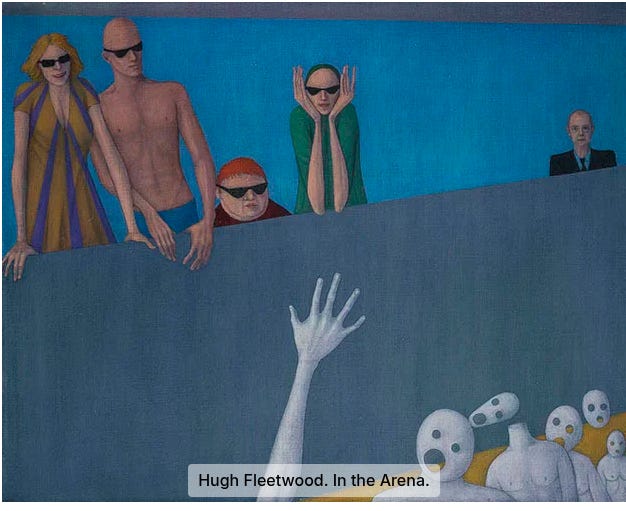
As a writer, Fleetwood’s chosen genre, from what I can tell, is the thriller, of a particularly dark variety. His paintings, what I’ve seen of them, possess a quite strange and eerie quality that appeals to me.
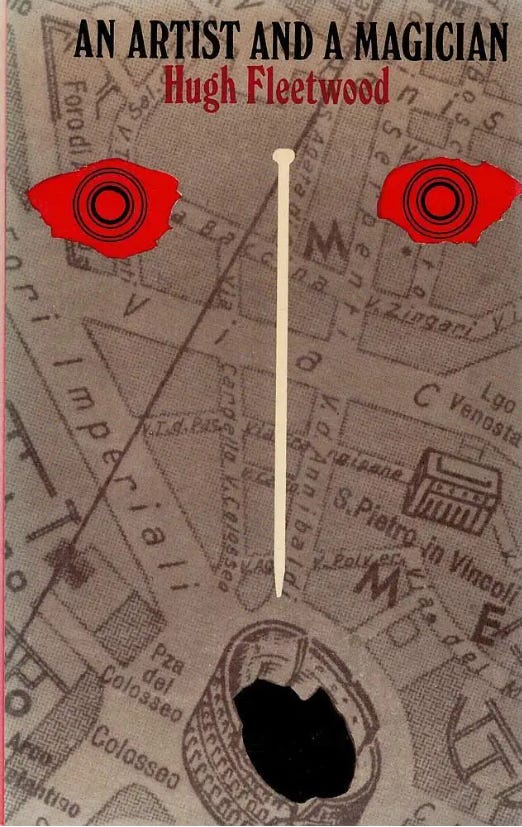
The novel I chose for this round is An Artist and a Magician (in the US it was called Roman Magic), published in 1978. The first of many surprises this novel has to offer can be found on the dedication page. It’s dedicated to George and Birgitta Cosmatos. Reading those names, I thought “Hang on a sec,” and did a quick Wikipedia search, which confirmed that An Artist and a Magician was, indeed, dedicated to the director of Rambo: First Blood Part II, Cobra, Tombstone (depending on who you ask, anyway), among other films, and his wife. I have nothing more to add to that, other than to say “Well isn’t that something.”
The novel is about a man nearing 60 named Wilbur George. He’s an American expatriate living in Rome. Once a published novelist, he hasn’t written anything of his own in years, and earns his crust doing the unusual job of translating screenplays, which allows him to add his own little touches, but which he gets no satisfaction from. He lives beyond his means as a frequent host of elaborate and carefully curated dinner parties. As the novel opens, it’s the morning after one such party that didn’t go well.
He had stuffed them with food, drowned them in wine and whisky, made up ditties, put on rag-time records, told his war stories and his cat stories and his stories of the old South — had even danced for them with a tambourine, going tap on his toes and bang on his bottom and hit hit hit on his head — and all they had done was sit there, smile politely, and tell him he was wonderful; and then go right back to their bickering and boringness. The ugly little Canadian lesbian had snapped at the pink and puffy portrait painter, telling him he was a snob, and the portrait painter had paid fulsome and embarrassing compliments to the old deaf princess. The old deaf princess had attacked the supercilious young writer for not being married and the supercilious young writer for not being married, and the supercilious young writer had ignored her and spent the entire evening condescending to some woman from New York with a little flowered expressing and a little black dress, who possibly, in other circumstances, could have been very nice, but last night had been as appetizing as a dish of cold and over-cooked rice…
He was, he supposed…too slapdash as a cook, and should take more care over the ingredients he mixed together. But that would have taken the fun out of things. And while, when disasters did happen they were dreadful, and made him feel depressed and mean, and made him regret having wasted his time and money, most evenings…were wonderful. Or at least, he enjoyed them. Inventing all those different characters, bringing them all to life…
As you may have detected from the above, Wilbur lives in Italy, but socializes largely with other expatriates. Those ingredients are, of course, the people he invited, and he was so pleased, usually, with his choices, that the very act of throwing these dinner parties, proved his status as an artist, a creator of “a court in which he was both the magician and the fool…”
Among those expatriates, and the ones he counts as his closest friends are an elderly British woman named Pam, and three Americans: Jim, Bernard, and Betty. However, he is careful to never have more than one of them over at his place at a time. The, or a, strange thing about those four, apart from the fact that each one was extraordinarily wealthy, every one of them hated the other three.
Quite why they hated each other so much he wasn’t sure. Certainly they had nothing in common apart from their inexhaustible supplies of money and their affection for him, but to have nothing in common was hardly a reason for the animosity they felt towards each other. And animosity they felt. Pam said that Jim was depraved; Jim that Pam was evil. Betty said that Bernard was rude; Bernard that Betty was fey… but it was a never ending circle, and all four of them…thought that above all, the other three were destructive forces who were preventing ‘dear Wilbur’ from, more than merely being a poet, painter, novelist, and actor, actually writing poetry, writing novels, painting pictures, and acting in plays.
All of which, we’re assured, Wilbur used to do. And it is his abilities in these artforms, and his desire to do them, that leads each of the four to supply Wilbur with extraordinary funds, which allow him to live as he does. Though slightly ashamed of this, and careful not to ask too much too often, and claiming to value them as actual people, Wilbur is comfortable with the arrangement, as the “four pillars” also seem to be.
Then, one day, he receives a letter from the tax office. It seems Wilbur owes six million lira in taxes. What he should have been doing is charging his clients, the ones who send him screenplays to translate, more than the fees he charged, so that the balance could be paid in taxes. This is a crushing blow. To get out from under this, he realizes he will have to ask one or more of the pillars for further, and substantial gifts. These are sometimes referred to as loans, though Wilbur does not think they actually expect him to pay them back. However, when Pam invites him to tea with urgent news, and he goes prepared to make his request, Pam, a woman in her 80s, informs him that she is planning on leaving Rome, for various reasons, and she wishes to start a new kind of life elsewhere. This, to Wilbur, is bad enough, but Pam twists the knife when she tells him that she wants no outstanding business between them, so that before she moves she expects him to pay back what he owes her, which is fifteen million lira.
As this horrifying meeting proceeds, Wilbur fantasizes about murdering Pam, out of rage. All he’d have to do, he knows, is knock her down in her garden, where due to her age and health, and her generally lonely existence, she would lay like an overturned tortoise, exposed to the elements, and subsequently die. However, he doesn’t do that, and is in fact horrified by his own fantasy. So he leaves, and begins trying to figure out how to get out from under a debt that has ballooned from six million lira to 21 million lira. His day worsens when he gets word from the other three pillars that they’re either broke (Betty, due to some legal mishap she expects to be cleared up), or is jetting off for God knows how long with his new thug of a boyfriend (Jim), or is seriously considering a move back to California (Bernard), thereby cutting him off from all the money he’s come to depend on.
But the next morning, his Irish secretary wakes him to inform him that Pam has, in fact, died, in exactly the way he fantasized, though without his having any part in it. This leads to three more things: a notice in the paper about Pam’s death which includes information that Pam had tried to write something in the mud of her yard. I’ll spare you the complicated linguistic issue that he believes he’s solved, but the gist is that he has reason to believe that what she was trying to write in the mud was “Wilbur.” Possibly as an accusation, because Pam sensed that his magic powers — which throughout the novel Wilbur will bounce between believing he actually possesses, to thinking he’s a terrible old fool for believing such nonsense about himself — caused her fall and eventual death. The other two things that happen, which set the rest of the novel in motion, is the fact that through an honest misunderstanding, and inattention, Pam’s daughter believes Pam would have wanted her close friend Wilbur to have some sort of inheritance from her — this inheritance is comprised of material objects, one of which contains a check that will cover his tax bill, with much left afterwards. Most importantly, he receives letters from each of the other pillars, all of whom believe, based on what they’ve read in the papers, including the bit about what Pam wrote in the mud, that Wilbur killed Pam. Moreover, they all seem delighted that he would do such a thing. Each letter also includes a check for Wilbur.
It’s not giving too much away, because I think any reader would suspect something like this is coming, when I say that this leads to further deaths of other pillars, and each time (in one case, the death is an especially brutal murder, which, again, Wilbur did not commit) the deaths come after Wilbur learns that this particular pillar refuses a loan to Wilbur. He comes to need this, because out of guilt, and after paying his taxes, Wilbur blew through most of the rest of Pam’s money on a guilt-ridden trip to Paris.
This is what makes An Artist and a Magician so compelling: Wilbur is not a murderer, not intentionally anyway, but he does become more and more convinced that his magic is the cause of the deaths. And because the others always believe he’s guilty of causing these deaths of people they despise, and because he still wants and needs their money, he plays along. He knows he didn’t do any of this, but a sinister side of his mind begins to overtake him and insist that he is doing it, because he keeps benefiting from it. He does this largely by not denying Jim or Betty’s suspicions, though he outright lies to Bernard, the one he values the most on a personal level, and says yes, he killed them. What I’m getting at here is that this novel is that rare thing: an actually original story. Unless, that is, you’ve read other novels about a man who only pretends to have murdered his friends.
As a plot, things proceed along these lines, and to get into too much detail would be to give away too much, and this novel is not impossible to get your hands on. Used copies aren’t priced through the roof. There are twists. And twists are funny things. The significance of one of the pillars in all of this — though not quite in what way they are significant — is somewhat telegraphed by Fleetwood. Telegraphed enough, anyway, for me to have picked up on it early. Another twist adds a somewhat magical quality to it all, in the sense that is there some magic in Wilbur, and that he might actually be responsible in the way he believes, but also can’t quite believe, he is? That twist comes quite out of the blue; no indication that it might be coming exists until it exists. This is fine, though, and doesn’t come off as a cheat because it ties in both to what we know about Wilbur, and thematically it slides right in with everything else.
One other thing I really appreciated about the novel is that while Wilbur might be considered both the hero and, depending on how you choose to look at it when the whole picture has been revealed, the, or a, villain, he is really the only moral person, at least of the five main characters. The other four are essentially monsters. The glee they take in the deaths of the others, their delight that Wilbur “has it in him” to do these things, as well as a series of outrageously grotesque revelations — which may or may not be true — having to do with why the four pillars hate each other, shows them all to be almost incredibly vile. Save, maybe, Pam, who dies too early in the novel for us to learn too much about her possibly closeted skeletons. But it’s a quite nasty novel, spiritually speaking (it is also, on the level of the absurdity of its plot, a kind of pitch black comedy) — this I expected. What I didn’t expect was for it to actual have a moral spine to it. For all the good that spine does anybody.
II. Everybody’s a Loser Today
Author Previously Read: Richard Ford
Books Previously Read: The Ultimate Good Luck; The Sportswriter; Wildlife
Book Read: Rock Springs
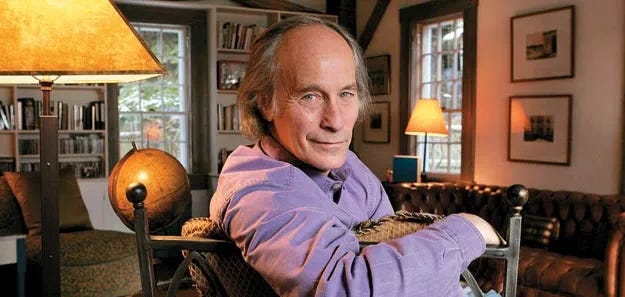
Richard Ford has written nine novels, four collections of stories, and one memoir. As of this date, I have read three of those novels, and one of the story collections, which is a little less than a third of his bibliography. Yet somehow, I’ve managed to have quite a lot of opinions about him. The first novel of his I read was his second, The Ultimate Good Luck, about which I have vague but generally positive memories, the novel having been read by me close to thirty years ago. I don’t know if Ford would describe it like this, but it’s essentially a crime novel, so points in his favor there. The two main things I remember about it are a passage in which our hero, whatever his name is, unloads a clip from his submachine gun into a hot water heater. Why he did that I don’t know, but I remember that bit being very well written. And then later in the book, that same dude is tied down, on his back, arms and legs immobile, and someone has placed a poisonous scorpion on his bare torso, which he struggles to shake off him without it stinging him. I remember when I worked in a bookstore, and one of my co-workers asked if I’d ever read Ford, and I told him about the water heater bit.
I’m going to jangle the timeline a bit and skip ahead to the third of his novels I read, Wildlife, a novel set in 1960 and which is about, as so much of Ford’s fiction has turned out to be, about a flailing marriage between two somewhat strange people, as seen through the eyes of their teenage son. I remember liking that one pretty well, within reason, and with a bit less enthusiasm than the already, let’s face it, tempered form of it I felt for The Ultimate Good Luck. But broadly positive, and I also liked the film that Paul Dano and Zoe Kazan made from it in 2018. The point being, though I want to be careful and not overstate this, things are looking reasonably sunny between Ford and me by now. In between The Ultimate Good Luck and Wildlife, however, I read his celebrated 1986 novel The Sportswriter (which, serendipitously, at least for my purposes, chronologically falls between the other two novels previously mentioned, in his bibliography). That novel was a big enough deal that I suppose it is now considered something of a modern American classic. It was also a big enough deal that Ford has spent the bulk of his writing career since then writing a series of novels about that book’s protagonist, a quite flawed fellow named Frank Bascombe. And I thought it was, you know, fine. More formal in its language than I remember being the case with The Ultimate Good Luck — I remember a curious absence of contractions, for one thing — and just generally thinking it wasn’t all it was cracked up to be.
What I’m about to get into, with regards to my opinions about Richard Ford, will strike some of you, if not many of you, if not all of you, as unfair. But Ford’s second novel about Frank Bascombe was Independence Day. Published in 1995, it would go on to win both the PEN/Faulkner Award for Fiction, and the Pulitzer. When I decided, one day, years ago, that I might as well give it a whirl, I cracked ‘er open, and read the first sentence, which is this: “In Haddam, summer gloats over tree-softened streets like a sweet lotion balm from a careless, languorous god, and the worlds falls in tune with its own mysterious anthems.” To put it plainly, I really, really hate that sentence. It strains so mightily for poetry, to be Literary, to be deserving of awards. Now, in the spirit of full disclosure, re-reading the rest of the opening paragraph today I discovered that what immediately follows that sentence isn’t all bad (unless you count Ford’s somewhat weird use of “Negro” in 1995 to be bad, which would be fair enough), but I was so repelled by that sentence at the time, and was again today, that I just couldn’t imagine myself continuing. One day maybe I will, but for the purposes of, and in the context of, this project, today is not that day. Still, because of the rules for this project that I’ve set for myself, Richard Ford was the best choice for this half of this round of posts. But which one?
Ah. Well. Yes. My first thought was to read his story collection A Multitude of Sins, from 2002. Why that one? What’s the big deal about that one, of all his books? Well I’ll tell you. That’s the book that Colson Whitehead reviewed negatively in the New York Times (which you can read, along with more details and thoughts about the incident I’m about to bring up, without a subscription to the NYT, here), which so angered the grown, adult human being Richard Ford that he actually spit on Whitehead at some gathering or other. Whitehead, for his part, seems to have taken it all in stride. Or rather, not in stride, probably, but knowing that everyone would be on his side when they learned of what happened, was able to be at least publicly somewhat good-humored about it. Inside, he probably wanted to punch Ford’s lights out, but being more aware of his position as grown, adult, human being, chose instead to act like one and not hand back to Ford some of his teeth. In the end, I chose to forego A Multitude of Sins, because however negative my feelings about Ford have become over the years, choosing that book would be setting him up to fail. Because even if I ended up liking A Multitude of Sins, I doubt any of the stories, however good I might believe them to be, would make me think “Well, okay, I’d have spit on Colson Whitehead too.” (And by the way, years before, and on a level that might be regarded as much more sinister, after she wrote a negative review of The Sportswriter, Alice Hoffman received a package from Ford that contained one of her own novels, riddled with bullet holes. Given that novel’s status, I might have chosen that for today, if I hadn’t read it already).
So I didn’t read A Multitude of Sins, but I did read Whitehead’s review. And if and when you read that review, I think you’ll agree that while Whitehead definitely didn’t like the book, the review is hardly the merciless hatchet job that Ford’s reaction would indicate. Whitehead even writes in it that he liked both The Sportswriter and Independence Day. He simply didn’t like A Multitude of Sins. And the way he describes it, I doubt I would, either. What Whitehead describes is the kind of book that people who never read literary fiction, and probably don’t even read good genre fiction, often claim all of literary fiction is comprised of. The cliche is that all literary fiction is about English professors seducing their students; what Whitehead describes isn’t that, exactly, but it is, so he says, one story after another, and then again after another, about adultery. A Multitude of Sins, Whitehead points out, is a bad way to describe one sin, repeated ad nauseum.
So if that book was off the table, which should I read? I’ll end the suspense here, since I’ve already told you.
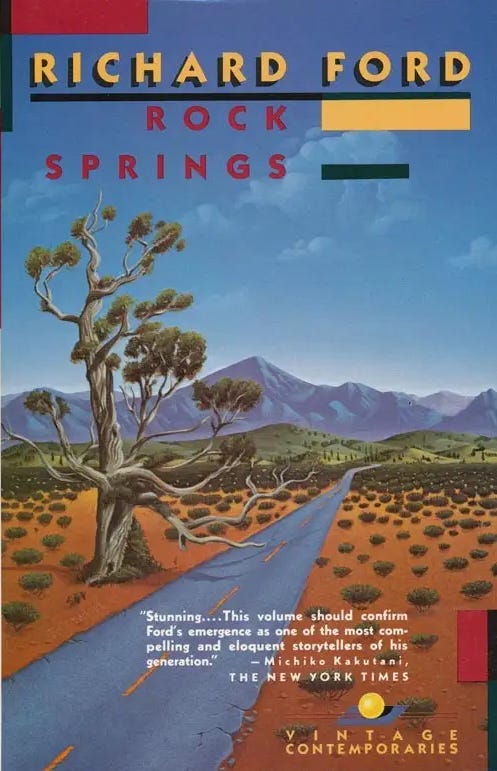
Rock Springs was Ford’s first collection of short stories, and his first book after The Sportswriter. It was regarded by many as a confirmation of the talents displayed in that novel (I mean, if they say so), and is still regarded as one of his best books today. A while back, some guy on social media, who had a bug up his ass about something or other and complained that nobody read good books and that current literary fiction was a bunch of dogshit, gave Rock Springs as an example as the kind of book he’d force people to read, if he had a say in such things. That alone should have turned me off of it, and it nearly did, but in the interest of giving Ford his fair day in court, Rock Springs seemed the best option.
And how was it? Withhold your spit, Richard Ford, because I thought it was pretty good. About as good as The Ultimate Good Luck, anyway, though arguably better in the sense that I remember a lot more of it, having finished it two days ago. The repetition that Whitehead so derided in his review of the later collection (I’m tired of typing out that title over and over again) is present here, but in defense of Rock Springs — and perhaps, by default, that other collection — I don’t think you can hold thematic unity against a story collection. And adultery does rear its head from time to time here, but doesn’t feature in every one. Almost all of the stories do feature a crumbling marriage, or romantic relationship, though the reasons can vary. The men are almost always at fault, though not all of the women acquit themselves admirably. Other things that pop up time and time again are booze, unemployment, Native Americans, Montana (no problem there, that just means Ford is a regional writer, that thing English 101 professors, possibly the same ones who seduce their students, talk about a lot), but also Florida — not as a location, rather as a dreamed of destination, or just a place — difficult parents to confused children, as well as, relatedly, the process of coming of age. If most of these stories share a fault, it’s that too many of them end with long stretches where the first person narrator (all but two of them are first person) reflecting on the past events he’s just told us about. For example, in the story “Children,” the narrator, George, presumably an adult telling a story about his teen years, and his friend Claude skip school, get some beer, and meet Sherman1, Claude’s dad, at a motel where they will pick up Sherman’s very young girlfriend Lucy, and take her wherever she wants to go. Sherman does none of this kindly, pulling his son out of the car by his hair, insulting both him and George, but giving them “shut up” money to not blab about any of this, as Sherman is, of course, married.
The three of them end up going fishing, or at least that’s what Claude ends up doing, while the girl, Lucy, who is only about 16, and George lounge around talking. Lucy is half-seductive in her conversation, but then at George’s age a girl simply speaking to him would come off as half-seductive. But Lucy’s life has been hard, and she’s fled home, though she feels guilty about it. George, in any case, even when given the opportunity, can bring himself to only go so far with Lucy. Claude and Lucy, however, go further, off out of sight of George, who spends the story in a state of melancholy:
…I did not, as I waited, want to think about only myself. I realized that was all I had ever really done, and that possibly it was all you could ever do, and that it would make you bitter and lonesome and useless. So I tried to think instead about Lucy. But I had no idea where to begin. I thought about my mother, someplace far off — on a flyer, is how my father had described it. He thought she would walk back into our house on day, and that life would start all over. But I was accustomed to the idea that things ended and didn’t start up again — it is not a hard lesson to learn when that is all around you.
The story ends with them dropping off Lucy, and George again entering a state of reflection:
Claude raised his fist and held it out like a boxer in the dark of the car. “I’m strong and I’m invincible,” he said. “Nothing’s on my conscience.” I don’t know why he said that. He was just lost in his thinking. He held his fist up in the dark for a long time as we drove on towards north. And I wondered then: what was I good for? What was terrible about me? What was best? Claude and I couldn’t see the world and what would happen to us in it — what we could do, where we would go… Outside was a place that seemed not even to exist, an empty place you could stay in for a long time and never find a thing you admired or loved or hoped to keep. And we were unnoticeable in it — both of us. Though I did not want to say that to him. We were friends. But when you are older, nothing you did when you were young matters at all. I know that now, though I didn’t know it then. We were simply young.
Not entirely dissimilar in tone is the end of “Sweethearts.” In that story, the narrator, Russell, and his girlfriend Arlene, and his daughter Cherry, are preparing to take Arlene’s ex-husband, Bobby, to jail for a series of non-violent, but serious, crimes. This is a good story, filled with a curious mix of tension and warmth. There is no animosity, at least not on the surface, between Russell and Bobby. Arlene, on the other hand, bounces back and forth, feeling affection and sympathy for Bobby one minute, and being filled with understandable resentment and disgust at the behavior that has led him to this point in his life. Bobby’s behavior on this day is somewhat manic, as one might imagine, trying desperately to see hope somewhere, while showing genuine, avuncular kindness to the little girl. Every so often his disappointment and bitterness will show through, sometimes for minor reasons, such as the fact that he doubts the prison (called Deer Lodge, which also pops up often in these stories) won’t have seafood, which he says he’ll miss. When Russell says “I bet they have fish of some kind there,” Bobby replies “Fish and seafood aren’t the same.”
Anyway, the story ends, again, with the narrator reflecting on matters:
[Bobby] and I were not alike. Arlene and I had nothing to do with him. Though I knew, then, how you became a criminal in the world and lost it all. Somehow, and for no apparent reason, your decisions got tipped over and you lost your hold. And one day you woke up and found yourself in the very situation you said you would never ever be in, and you did not know what was most important to you anymore. And after that, it was all over. And I did not want that to happen to me — did not, in fact, think it ever would. I knew what love was about. It was about not giving trouble or inviting it… It was about never being in that place you said you’d never be in. And it was not about being alone. Never that. Never that.
This passage, like the end of “Children,” and others in Rock Springs, can be boiled down to “Life’s a real pisser.” This is not a sentiment I’m in any position to refute, but this kind of writing can feel a little bit like Ford taking a moment to explain to the reader the story they’ve just read.
But the faint air of menace that hangs over “Sweethearts” becomes more pronounced in two of the best stories in the collection. In “Empire,” the longest story, a man named Sims and his wife Marge are travelling by train. Marge, who we’ll learn has been through some stuff, booked a sleeping car (a “roomette” is how Ford describes it), and she goes to bed early, leaving Sims on his own to just sit and occasionally talk and half-flirt with a female Air Force sergeant named Benton, who is drunkenly travelling with a bunch of her colleagues. Sims is mostly aimless, trying to keep his head straight, and staring out the train window.
The train was coming into a station when he looked in on Marge. There was one main street that came straight up to the main tracks. The sky was cloudy in front of a big harvest moon. Down the street were red bar signs and Christmas lights strung across one intersection. Here was a place, Sims thought, you’d want to stay drunk in if you could.
This kind of writing gets into the heads and under the skin of his characters than any of Ford’s “I know what love is about” prose does. While Sims, with nothing much to do, tries to ignore his interest in Sgt. Benton (“Killing time led to trouble, he’d found”) he remembers a time when Marge was in the hospital for an operation for a probably cancerous tumor. During that time, having taken time off work, he spent all his time at the hospital with her, until he had to go home, where he ate standing up in the kitchen and fell asleep in front of the TV most nights. But one evening he noticed, through the window of his neighbor’s house, a woman named Cleo, the troubled sister of the woman who owned the house with her husband, weeping at the kitchen table. He eventually goes to see her, hoping, I believe sincerely, to help her. She tells her a wild story of having a boyfriend who was part of a Satanic biker gang called Satan’s Diplomats, all of whom eventually turned on her and threatened to rape and kill her. How she got away from them is not entirely clear, but she and Sims develop a kind of friendship, bound by their troubles.
Marge’s illness was his terrible worry, he thought, and he didn’t know what to say. Marge was sick and might die. And he hated the whole thought of it. He loved Marge, and if she died his life would be over. No ifs or ands. It would just be over. He’d already decided he’d go out in the woods and hang himself so no one but animals would ever find him. That didn’t make good conversation in the middle of the night, though. Nothing he or Cleo could say would help any of that. He was happy to sit across from Cleo, who was pretty, and get peacefully drunk and forget about illness and hospitals and people’s puny insurance claims he wasn’t processing.
However, Sims does eventually sleep with Cleo, and it’s possible that later he sleeps with Sgt. Benton. He certainly goes to her cabin, drinks with her, flirts, and wakes up in her bed. That he’s fully dressed and can’t remember what happened allows for the possibility that he didn’t. He would have, though. Furthermore, after his night with Cleo, he begins getting calls from a member of Satan’s Diplomats saying he’s going to kill Marge, and Sims. Nothing comes from it, but over the phone he hears a woman laughing, cackling, at the man’s threats. He assumes it’s Cleo. Killing time can lead to trouble. “Empire” ends with fewer ruminations from Sims, other than his belief, as he gets into bed with his sleeping wife, that he feels insufficient. Ford may revisit adultery as a subject too infrequently, but he does seem to disapprove of it. “Empire” also, in some respects, resembles the least significant story in the collection, “Going to the Dogs,” in which the narrator has a good day drinking with a couple of women from the same trailer park where he’s visiting friends. Things are so loose that he retires to the bedroom with one of them. The other simply waits elsewhere in the trailer, saying she’ll do some cleaning. But once they’re gone, he discovers they’ve cleaned out his wallet. “…there was nothing but some change and some matchbooks, and I realized it was only the beginning of bad luck.”
My other favorite story in the collection has the perhaps too ironic title “Optimists.” It’s told from the point of view of a young kid named Frank whose parents are in a good position financially because of the dad’s good union railroad job. However, that situation is becoming dicier by the month. The son, however, senses that for all the talk about it, they’re not really worried. Then, one night, while Roy, the father, is working and the wife is hanging out in their kitchen with friends, Boyd and Penny Mitchell, an accident occurs at the railroad. Roy comes home ashen-faced, explaining that he saw a man killed. A hobo, probably, whose hand and foot were cut off by a rolling train car. He’s horrified, but for some reason Boyd Mitchell begins tearing into him, saying that Roy needn’t have let the man die, if he’d had any sense or compassion he would have tied the man’s wounds with tourniquets. When Roy protests that he doesn’t know anything about that, and that the man was too far gone anyway, Boyd says “That’s only for a licensed doctor to decide… You’re morally obligated to do all you can.” This situation heats up until Roy snaps and punches Boyd in the chest with everything he has, killing him. It was unintentional, but that’s it. Optimism gone, life over. Deer Lodge, here he comes. Roy flees, but is quickly caught.
[My mother] and I sat in the brightly lit living room, with Boyd Mitchell dead on the floor, and simply looked at each other — maybe for ten minutes, maybe for twenty. I don’t know what my mother could’ve been thinking during that time, because she did not say. She did not ask about my father. She did not tell me to leave the room. Maybe she thought about the rest of her life then and what that might be like after tonight. Or maybe she thought this: that people can do the worst things they are capable of doing and in the end the world comes back to normal. Possibly, she was just waiting for something normal to begin to happen again. That would make sense, given her particular character.
I’m no optimist, but, and probably because I’m not, that line about “waiting for something normal to begin to happen again” feels very familiar to me. Though the story doesn’t suggest this is much of a factor, the question of infidelity is raised, because Roy wonders why Boyd would speak to him like that; is it possible that the reason was because he had designs on Roy’s wife, and wanted simply to antagonize his rival? Interestingly, there is no firm evidence that this was the case. It’s simply romantic paranoia.
The last story in the collection is called “Communist.” It’s about a communist named Glen Baxter, who is the narrator’s mother’s current fella. Given the title, and Baxter’s politics, the story is curiously just to one side of being political. That’s not to say the story is apolitical, but it would be hard to say where Ford lands on this divide. Baxter is not a sympathetic character, but that fact, also, seems to be separate from his politics. He’s an enthusiastic goose hunter, and a slightly cruel one. He takes the son, Les, out goose hunting, which the boy is happy to do. They go to a spot at a nearby lake that is almost wondrously filled with beautiful white geese, which the two men open fire on.
By now the whole raft was in the air, all of it moving in a slow swirl above me and the lake and everywhere finding the wind and heading out south in long wavering lines that caught the last sun and turned to silver as they gained a distance. It was a thing to see, I will tell you now. Five thousand white geese all in the air around you, making a noise like you have never heard before. And I thought I myself then: this is something I will never see again. I will never forget this. And I was right.
Glen Baxter shot twice more. One he missed, but with the other he hit a goose flying away from him, and knocked it half falling and flaying into the empty lake not far from the shore, where it began to swim as though it was fine and make its noise.
Glen stood in the stubby grass, looking out at the goose, his gun lowered. “I didn’t need to shoot that one, did I, Les?”
“I don’t know,” I said, sitting on the little knoll of land, looking at the goose swimming in the water.
“I don’t know why I shoot ‘em. They’re so beautiful.” He looked at me.
“I don’t know either,” I said.
“Maybe there’s nothing else to do with them.” Glen stared at the goose again and shook his head. “Maybe this is exactly what they’re put on earth for.”
“[W]here it began to swim as though it was fine” is a tough image, for me anyway. Eventually, Les’s mother, who was against this trip all along, shows up, takes note of the wounded goose, and berates Glen for his cruelty until he finally puts it out of its misery with a series of barely aimed shots from is pistol.
Maybe there’s something here about collectivism versus the individual, and that Communism is bad for both. I imagine that could be the case, though, my own political leanings aside (they do not lean towards Communism), that feels a little bit trite. And if so, I choose to ignore it, because I liked the story, and appreciate that it gets to a more ground-level truth, which is that whatever a person’s stated views about what is right and wrong for society, no matter how passionately and righteously they may hold them, that does not necessarily mean anything about who that person is as a human being. I don’t know how often this needs to be proved in real life before people will let it sink in.
* * * * *
This post is the latest in what will turn out to be a very long series of essays about my year of reading, from 2025 to apparently the end of time. For more details about this project, please read this post.
There are two characters named Sherman in this book, as well as two named Les, and also two named Claude. I do not think they are suppose to be the same Sherman or the same Les or the same Claude. Anyway, the second Sherman is only mentioned in passing.