
Always a Bad Idea
On Terry Gilliam's "The Imaginarium of Doctor Parnassus" and Jacques Lacerte's "Love Me Deadly"

[As I suggested I might do when I announced this round of posts, to give me more time to get this shitload of reading done, but keep the posts coming at a somewhat regular pace, I’m doing the movies first, before the books, this time]
I. No Black Magic, Only Cheap Tricks
Film: The Imaginarium of Doctor Parnassus
Director/Writer: Terry Gilliam/Gilliam & Charles McKeown
Have I Seen Anything Else by This Director and/or Writer: Yes. Gilliam: all the Python stuff including Monty Python and the Holy Grail; The Crimson Permanent Insurance; Jabberwocky; Time Bandits; Brazil; The Adventures of Baron Munchausen; The Fisher King; 12 Monkeys; Fear & Loathing in Las Vegas; The Brothers Grimm; Tideland; The Zero Theorem; The Man Who Killed Don Quixote. McKeown: Brazil (with Gilliam and Tom Stoppard); The Adventures of Baron Munchausen (with Gilliam); Ripley’s Game
While it’s accurate to say that I had not seen this film until just recently, when I first bought the DVD I did give it a spin and was for some reason completely enervated by it within about 15 or 20 minutes, and never went back to it. However, I should mention, and I don’t know if I’ve said it in one of these posts specifically, but I know I’ve said it online, that by and large I think nostalgia is a poison, and that the tendency to cling to that culture you embraced as a child well into adulthood is making everybody stupider by the day, there are still some things that one liked as a child that as an adult whose curiosity has hopefully led them into all sorts of interesting corners of art from all over the world, still hold up to these more sophisticated tastes as being good, and one of those for me, or rather twelve of them are, for me, the films of Terry Gilliam.
The best of them have really not dulled over the years. Watching Brazil, which is still something I do on a pretty regular basis, is never less than an inspiring and invigorating experience, however ironic those feelings may be, given the film itself. I can still marvel at what he was able to pull off under extraordinary constraints with The Adventures of Baron Munchausen, the complete appropriateness that in Gilliam’s early years, he was associated with the film production company co-founded by George Harrison, Handmade Films. Because nobody’s movies, working at the level Gilliam was when he first broke out (almost to his detriment, as it turns out) looked more enticingly and enchantingly handmade than Gilliam’s. But partly because of this, I can imagine what some of my misgivings about the film may have been when I tried to watch it in 2009, or whenever it was.
Part of it, I think, is that what was so familiar about the film early on, so Gilliam-esque about it — and by that I mean the Renaissance-era style sideshow/traveling theater and magic show set, plying its wares, completely anachronistically, in the modern world as we know it, this sort of thing by now was feeling a little bit old hat from Gilliam. Add that to the fact that when the more appealing grunge of that traveling theater gives way to a more effects-heavy fantasyland not too far into the film, it looks anything but handmade. For what I’m sure are entirely budgetary reasons, and for the first time it’s really been noticeable, at least to me, Gilliam begins to lean on computer effects. And not only is that sad, just on its face, but the effects are not very good. The colors are also very bright, though this very vividness will wind up being somewhat ironic. But for while, watching the film, and seeing the different ways Gilliam has employed fantasy landscapes throughout his career, whether those landscapes can be taken literally within the confines in the story (Baron Munchausen), are part of a delusion (The Fisher King, Fear & Loathing in Las Vegas), some mixture of the two (Time Bandits, and, let’s face it, Munchausen), or some encroachment of an unwanted future onto an as of yet not completely spoiled present (12 Monkeys), those landscapes always have a look of having existed, in whatever form they exist, for a very long time, and have been kicked around a bit. Too often, when the imaginarium of the title is breached, the effect is one of someone having just called you over to the computer to look at this thing they just made.
However. Another problem I probably had was the similarity of the too-whimsical title The Imaginarium of Doctor Parnassus to that of another movie from around the same time, Mister Magorium’s Wonder Emporium, a film the existence of which I dreaded then, and still dread to this day. I didn’t want an aging Terry Gilliam to become more whimsical. I wanted him to become more bilious. And one reason I was excited to finally watch this movie is that history has proved that I needn’t have worried. While by no means his best film, 2013’s The Zero Theorem imagined a suitably grotesque future, and, better still, much better still, a film I would count as one of Gilliam’s masterpieces, the long-embattled The Man Who Killed Don Quixote, which gestated and changed over many false starts over a good decade-plus, against Gilliam’s will, but the version he made is the version he made, and I saw it in the theater in 2018. I loved it. And that film now feels like Gilliam reacting, with some bile, even some spite, to the work he’d done in the past. It’s Gilliam’s Unforgiven.
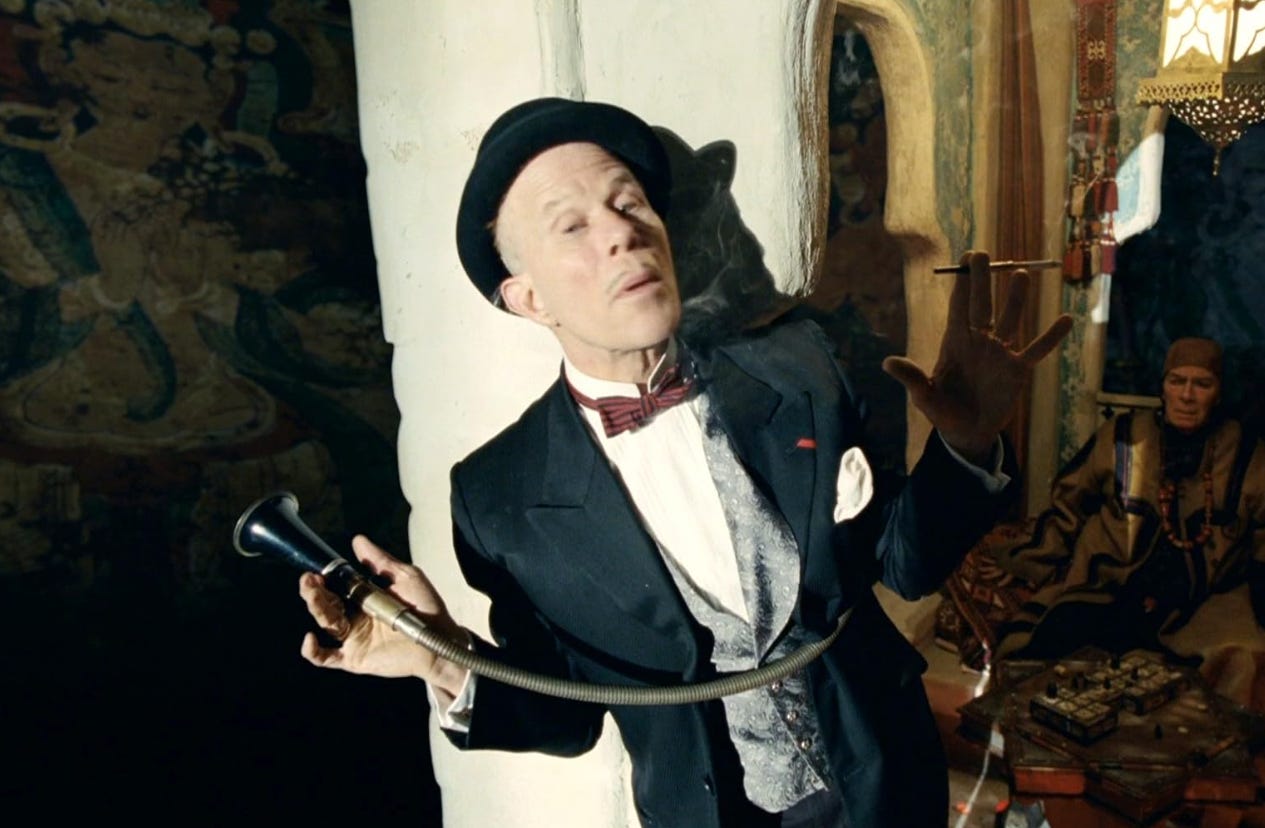
By now, it’s probably not a great idea to get too deeply into the plot, but to some point I’ll have to in order to explain what a strange experience this film is, if you haven’t seen it. The aforementioned troupe of players is made up of Doctor Parnassus (Christopher Plummer), his daughter Valentina (Lily Cole), a young performer and carnival barker named Anton (Andrew Garfield, who I had no idea was in this), and a midget and probably all-around utility player Percy (Verne Troyer). Essentially the deal is this: Parnassus is immortal, having gambled and won a kind of monkey’s paw wager with the devil, known here as Mr. Nick (Tom Waits, who’s in it a lot more than I expected, to the film’s benefit). Well into his years as an immortal walking the earth, one day Parnassus meets the woman who will turn out to be Valentina’s mother. Parnassus makes another deal with Mr. Nick: if Mr. Nick will restore Parnassus’s youth, while maintaining his immortality, so that he can better woo this woman he loves, then the soul of any child born from that union will belong to Mr. Nick on the child’s 16th birthday. A deal hastily made, as Parnassus reflects at the film’s beginning, which is three days from Valentina’s 16th birthday. But ever the gambler, Mr. Nick has a new proposition: whichever one of them can win five souls between now and Valentina’s birthday will get her soul. What Mr. Nick winning souls means should be self evident; what it means for Doctor Parnassus to win souls is never quite clear, except that when it happens later on, it’s clearly a positive experience for the people whose souls he’s won.
By this time, a new member has joined the troupe. One night, they find a man hanging by his neck, from a rope, tied to the underside of a bridge. They take the man down, and find that he’s managed to survive, via some gadget-y conceit which don’t you worry, will be called back to. Anyway, this man is Tony Shepard, played, mostly, by Heath Ledger. As I’m sure most of you know, this film’s production, one of many productions in Gilliam’s career to face near-project ending hardships, was almost upended completely when Ledger died suddenly. I don’t mean to be flippant about the young man’s death, but in terms of the movie, there was now a serious problem to be solved. In the film, the imaginarium is on some level the inside of Parnassus’s brain. And when visitors cross over the mirror-y facade the troupe set up, they enter a bright fantasy land that conforms to their wishes for happiness. It’s best, we’re told, to not bring in more than one person at a time, because the conflicting wishes can cause havoc. But when Tony, who claims to have amnesia and to not know how he ended up hanging from the bridge (though he does know about the gadget that saved his life, hmmm, curious) joins the show, he becomes the one to, well, shepherd customers across, into the imaginarium (this is also much to the consternation of Anton, who is jealous of Tony’s new higher status in the show, and of how Valentina, with whom Anton is in love, seems to dote on him), the women he brings begin to see Tony as appearing as their greatest desire, which the script was reworked to mean not Heath Ledger, but first Johnny Depp, then Jude Law, and finally Colin Farrell. Farrell is in the film the most of those three, second only in screentime to Ledger, and in fact is in the role of Tony when Tony’s part in the film comes to an end — Depp and Law feel like little more than cameos. And Law is further hampered by the fact that his sequence calls for the most unfunny slaptstick muggery of any of the Tonys. And while actors mugging is not unheard of in Gilliam’s filmography, Law is a bit egregious. On the other hand, Ledger plays the humor pretty broadly, and he’s quite good. He’s a funny and charming rogue!
Now, I don’t want to spoil anything here. But where the film goes with Tony really took me by surprise. The film darkens to such a pitch, in a number of ways (there are two deaths that I did not see coming), that even when Gilliam can’t help himself by unspooling a string of fairy book platitudes about storytelling, and how storytelling will save us from fascism, and all that other kind of hoo-haw, the cynical, sick of this shit misanthrope side to the filmmaker, which has always been there in Gilliam but which finally really flowered in The Man Who Killed Don Quixote, began its earliest bloom here (well, in Fear & Loathing in Las Vegas… and Python), in the last whirlwind half hour or so of The Imaginarium of Doctor Parnassus, when whimsy gets kicked in the nuts.
II. Affection for the Deceased
Film: Love Me Deadly
Director/Writer: Jacques Lecerte
Have I Seen Anything Else by This Director and/or Writer: Nope, he didn’t make any others.
Listen, I didn’t really know what to expect with this movie. Although I suppose at the time I purchased it — probably in a Kino online sale, although the disc is not Kino, but Code Red (now defunct, I believe, correct me if I’m wrong), but I believe Code Red sold through Kino’s website, and was part of there sales, at one time — I suppose at the time I purchased it, I say again, I must have had some expectations. This cover suggests certain things:
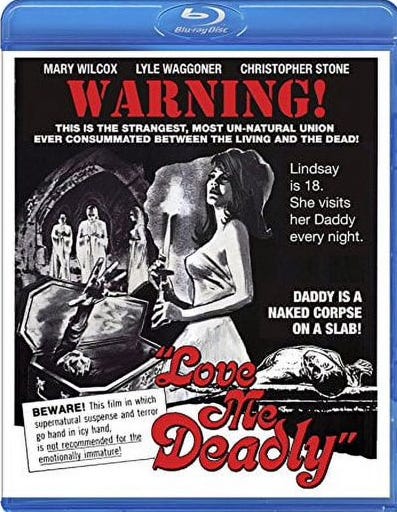
and I would never deny that I’m up for a sleazy good time now and again, plus this is clearly going to be some low budget genre thing, and who doesn’t love those? And if it turns out to be great, good! If it turns out to be bugfuck insane, well, that’s what it turned out to be. I don’t know, I thought maybe it would be about someone murdering strippers in L.A., and only a fan of strippers could stop him.
But no. After a long opening credits sequence featuring a man playing in a park with his young daughter, we jump ahead to we will correctly assume is that little girl as an adult. Lindsey Finch (Mary Wilcox) is dressed in black, with a veil, and is attending a funeral, or at least a viewing. She makes a point of being the last person to leave the church. She goes up to the coffin, leans in, and doesn’t so much kiss the lips of the male corpse within, as rub her mouth on his beard, though I believe “kissing” was the idea you were supposed to take away from it.
Several things happen very quickly at this point. First, Lindsey throws a party. At the party is a blonde hunk of a fellow named Wade (Christopher Stone), with whom Lindsey apparently has some sort of past. She invited him to her party after all. At one point, Wade follows her upstairs, makes his move on her, is rebuffed, and then tries to rape her, backing off only when she scratches his face. “Fine, then!” seems to be his attitude after that, and he storms out.
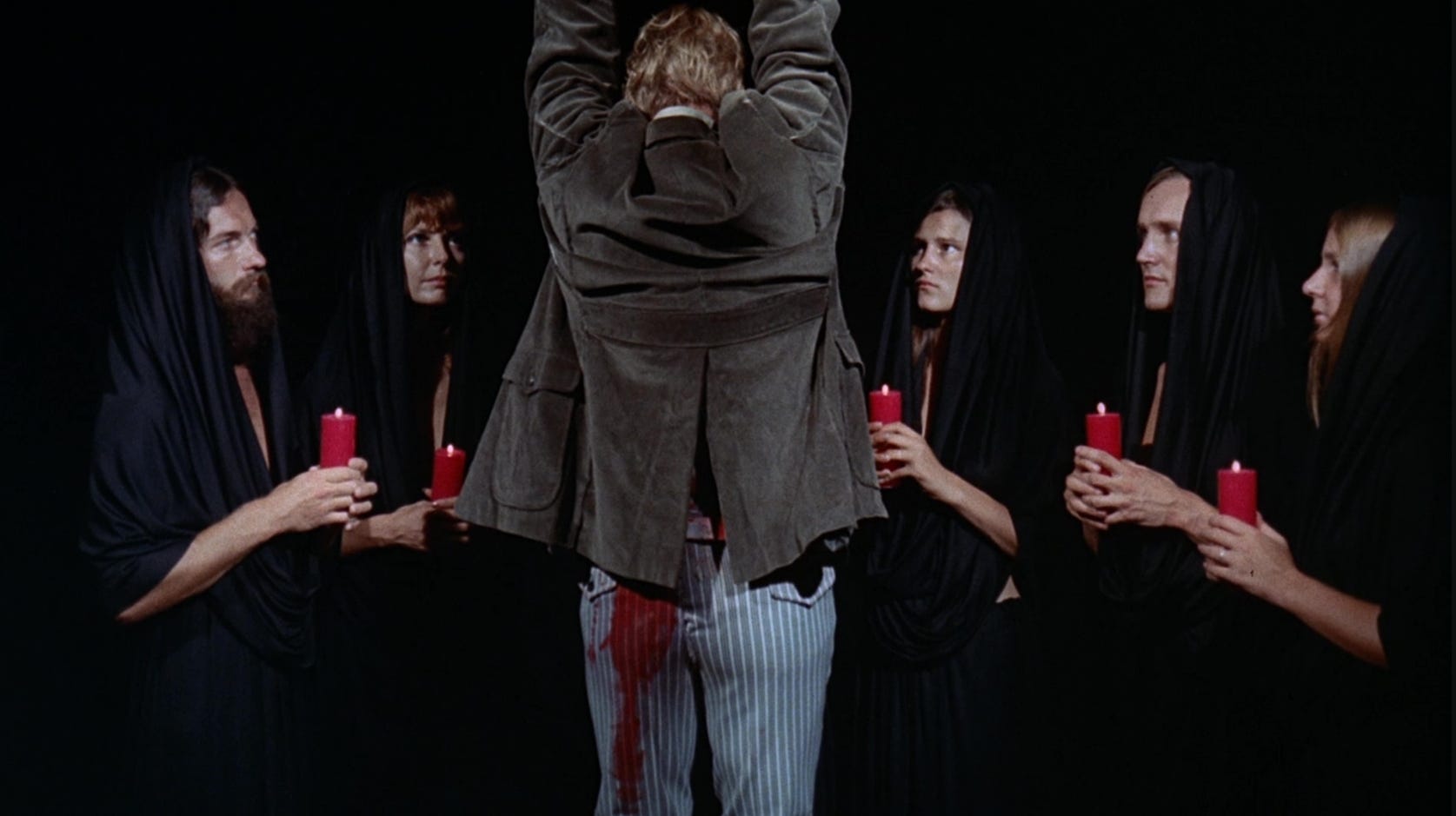
Then we meet a man who will turn out to be Fred McSweeney (Timothy Scott), a man we will come to learn runs the funeral home that Lindsey, we will come to learn, frequents. McSweeney is out tooling around town looking for a male prostitute. He finds one, and for an extra $10 over the asking price, this young man agrees to complete the transaction at McSweeney’s place of business (he claims he’s a veterinarian) because they can’t go back to his home, as he’s married. Anyway, in the mortuary, long story short, McSweeney kills the young man (a process that involves cutting up his neck, leading to the victim shouting “My blood! My blood!”, a sort of audio companion to the already rather straightforward visual component). The next time we see Lindsey, she’s at another funeral, this one being overseen by McSweeney again, who by now has started to notice her. He confronts her outside later, and announces that he has come to the realization — jumped to the conclusion, more like it, based on his thin evidence, even though he turns out to be right — that she’s a necrophiliac. Well, so is he! A match made in heaven, you might think, but you’d be surprised how many complications can arise.
For one thing, Lindsey is understandably and and rightly ashamed of her desires. McSweeney isn’t, and invites her to a kind of necrophiliac orgy. He softens the subject by saying things like “You’re not alone. In our group we have several members who... who participate” which only makes it sound worse.
Anyway, it’s the damnedest thing, this movie. In the film, Lindsey continuously follows McSweeney’s lead (he doesn’t let her in on the murders, which are on occasion carried out by his minions who work for him at the mortuary, and a real Bloodsucking Freaks-ian crew they are), only to recoil from it. She retreats to the arms of Wade, the guy who tried to rape her, and the idea that A) all is forgiven, and B) perhaps he can be her savior lands on the viewer, in 2026, a little off-balance, let us say. But on the other hand, already introduced into the mix is an artist named Alex Martin (Lyle Waggoner), a much nicer guy who she met at Alex’s brother’s funeral. The two seemed to hit it off, but then Alex drops out of the film for a long time. That is until Lindsey and Wade start dating, which results in one of the longest “we’re on a date!” montages I’ve ever seen, during which, by the way, the very controlling Wade sort of drifts into the background as Alex reappears, and is favored by Lindsey. Suddenly Wade, who doesn’t like Lindsey doing anything without him, seems okay with it all. One reason Wade is such an odd figure is that by the time he’s written out of the picture, you start to realize how much trouble writer/director Jacques Lacerte went to in order to devise some way to satisfyingly conclude this subplot he’d inadvertently created for himself by accidentally writing Wade into many scenes long after his usefulness was over, which was after he tried to rape Lindsey.
This ties into the other really weird thing about this movie. Wade’s fate is tied into murderous necrophiliac cult plotline, as I bet you’d already guessed, but so much of the movie is about the difficult relationship that Lindsey and Alex, now married, have found themselves in. Sexually they are completely incompatible (meanwhile one reason Lindsey might drift towards Alex over, say, a corpse, is because he reminds her of her father, which also suggests an incestuous side to all this), and long stretches of the film are about that. It’s almost as if Lacerte wanted to make a movie about what a rough gig he imagined being a necrophiliac must be, but figured he’d need to juice that premise a little bit with some thriller tropes, to drum up interest. But it is through those thriller tropes that Lacerte creates some truly memorable images, and the whole thing is so fucking cock-eyed, with a climactic rush of dot-connecting flashbacks that explains less than it thinks it does. The father obsession I get, they explain that, but how and why it took on a sexual component never is. Not that I need it explained, who could it explain something like that to anyone’s satisfaction, but the film seems to think everything is cleared up by the end. But with a film like this, I would almost be disappointed if I thought the filmmaker had better control of what he was doing than this.
* * * * *
This post is part of a series that is separate from, but related to, and will probably at certain points merge with, my Reading Project. For my details of what I guess is my Film Project, click here.
When whimsy gets kicked in the nuts: The Reader's Digest Condensed Version of Life.