
God Blinked
On Pedro Almodovar's "Talk to Her" and Geoff Murphy's "The Quiet Earth"

I. Nothing is Simple
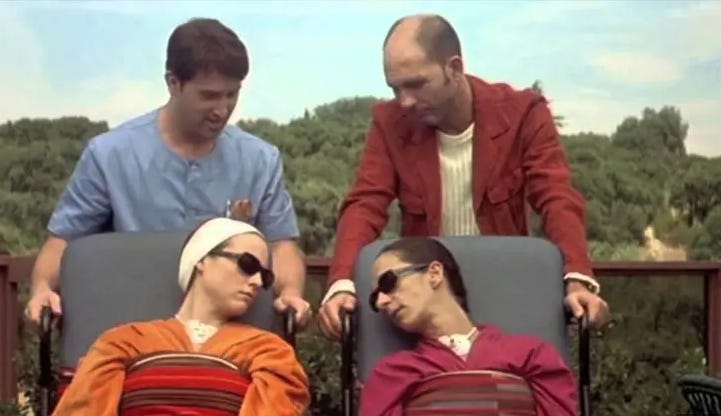
Film: Talk to Her
Director/Writer: Pedro Almodovar
Have I Seen Anything Else by This Director and/or Writer: Yes, but only Tie Me Up! Tie Me Down! and The Skin I Live In
In the realm of contemporary international cinema, Pedro Almodovar is one of my bigger blind spots. I don’t really know why. There are several of his films I’d like to see, and as I believe I’m about to prove I own some of his movies. But the man is fairly prolific, and before yesterday I’d only seen two of his films, and one of those two, Tie Me Up! Tie Me Down!, which I saw back when it was still considered scandalous, has pretty much completely faded from my memory (well, I remember parts of it). The Skin I Live In, which immediately sounded interesting to me when it came out, but which I only saw fairly recently, by which I mean within the last ten years or so, anyway, I remember that one much better, and I quite liked it. And Talk to Her has always been mentioned as a particular strong film, so here we are.
And it’s a very interesting film, with which I’ve been struggling. It’s a film about two men, and the two women in comas who they care for, and about. The two men don’t officially meet until some ways into the picture, but Talk to Her opens with them, complete strangers, sitting next to each other at a modern dance performance. One of the men, Marco (Darío Grandinetti) is so moved by the performance that he begins weeping. The other man, Benigno (Javier Cámara) notices this, and the next time he’s at his job, caring for a beautiful coma patient named Alicia (Leonor Watling), he tells her about it. Against all medical evidence, Benigno believes she can hear and understand him.
When the two men meet again, it’s when Marco comes to visit the woman he loves, a famous and controversial female matador named Lydia González (Rosario Flores), whose recent and uncharacteristically frozen performance in the ring left her gored and comatose in the same clinic where Benigno cares for Alicia. Because of their shared experience, caring for beautiful coma patients, the two men become friends, and the men share their pasts. Marco is a journalist who was working on a story about Lydia González’s fraught and very public personal life, when the two of them fell in love. Now that she’s in a coma, however, and much to his shame, he feels himself withdrawing from her. Benigno tells him he has to talk to her, that she can understand, or at least he believes she can, because how can we really know so why not believe? And that is important that she knows he’s there and still cares for her. This is why he talks to Alicia, of course, a young woman he knew briefly before her accident.
Benigno lived across the street from the dance studio where Alicia attended class, taught by a very odd Geraldine Chaplin. He became enchanted with her. The two meet and hang out and get along, but Benigno is a bit obsessive, and when he learns that Alicia’s father is a psychiatrist who works out of his home — which means Alicia is also there — Benigno sets up an appointment with the man, where, for his own reasons, he chooses to mislead his therapist by making him believe that he, Benigno, is gay. Alicia, seeing Benigno at her father’s office, becomes not unjustifiably put off a little bit, and the two stop hanging out. The next time he sees her is when she arrives, comatose, at his clinic, where her father (Roberto Álvarez) pays extra to have Benigno and another nurse (Mariola Fuentes) to care for Alicia exclusively.
Okay, so here’s where it gets interesting. I knew I was at least in intriguing hands when Talk to Her opens, after the credits have run, with a curtain rising. In the narrative, the curtain is rising on the dance performance that Marco and Benigno both attend, but you know, and I know, and Almodovar certainly knows, that the curtain is also raising on the performance that is Talk to Her. Almodovar is a somewhat less depressed version of Todd Haynes, in that both directors embrace the concept, form, and style of melodrama, not ironically, but with the full understanding of the artistic possibilities inherent within it. Those possibilities are both of a stylistic and emotional nature. And since a certain overheatedness is part of the nature of melodrama, to create melodrama intentionally, as Almodovar is doing here, is to be somewhat more forthright about the performative nature of art.
As far as the emotional element goes, you have to be built to go along with that level of stylization to feel it, but Almodovar even comments on that in interesting ways. This is where Marco comes in. The guy cries at anything. He’d cry at a bean commercial, if it was a sad bean commercial. But I’m not kidding, this is almost his defining characteristic. Lydia notices this about him, and is drawn to it, when she witnesses him tearing up at an outdoor concert they’re both attending, with a string quartet supporting a solo (and, on my old-ass DVD, curiously unsubtitled) singer. In these sometimes bold, sometimes rather quiet ways, Almodovar is wondering at human beings’ capacity to be moved by any art, which is by definition artificial. And if it is, by definition, artificial, why not embrace that?
But late in the film, a twist is revealed (I will pause here to note that I saw this coming the moment the first clue was dropped, and I am not normally good at predicting this sort of thing), and, predictable or not, it’s a barn-burner. In that it sets the whole movie ablaze.
I’m now going to make a comparison that anyone familiar with both Talk to Her and the thing I’m about to compare it to might think is a little crazy, but bear with me. Some years ago, and I can’t seem to stop bringing this up, I gave in to my naturally morbid curiosity and read Samuel R. Delany’s justly infamous psycho-porn novel Hogg. Without going into detail, that novel is 200+ pages of non-stop sadistic depravity. And I’m not talking about consenting adults doing things I personally think are disgusting (well, I guess there is some of that, to be fair), but I mean rape and murder, all from the point of view of the rapists and murderers, in particular the titular Hogg and the young man he has kidnapped and abused into accepting that they have a “relationship” now. Upon finishing it, and understanding Delany to be a serious artist, and unable to come up with an answer myself, I decided to see if I could find out why Delany wanted to write such a book. What his artistic motivations were. I found some information in that regard, the one bit that has stuck with me being that Delany said, in one interview or another, that part of his goal was to see if he could make the reader feel sympathy for a character like Hogg. I knew what he was referring to, because Hogg ends on a note implying that something’s about to happen that will make Hogg unhappy, something that perhaps might even be a blow to his heretofore outsized self-confidence. But how Delany could imagine anyone who read all of Hogg would come away thinking “Oh well, that’s too bad. I wouldn’t wish that on my worst enemy,” rather than thinking that what Hogg really deserves is nothing less than a bullet right in his forehead, is beyond me. I’m sure there are such readers out there. I wouldn’t want to meet any of them, but I guess there must be at least a couple dozen of them.
Now what is eventually revealed about Benigno may not, in the eyes of some, reach the heights of horribleness that are encountered in Hogg, but come on — it’s pretty fucking close, at least. And if it’s not right smack dab on the same level, it’s only because Almodovar insists that however misguided Benigno’s, let’s call it, affection might be, it is nevertheless genuine to him. He’s not a sadist. He’s just a sick deluded bastard.
Yet despite it all, Marco, when he learns of all this — I’m being coy about it, but you can probably piece it together — is horrified, yet sympathetic. The horrified part is interesting, because there are a couple of sequences near the end, when the film has ramped up into a brief version of a melodramatic thriller, that I believe very consciously nod, in their shot selections and particular settings, to 90s thrillers, specifically The Silence of the Lambs and The Usual Suspects. So Almodovar recognizes the unforgivability of what Benigno has done. His best friend at the clinic will no longer speak to him. But forefront in Marco’s mind — and when the two men reunite, by the way, is some months after the reveal and fallout — is the fact that Benigno is his friend. Marco cries at everything, and when he cries on Benigno’s behalf a display of perhaps the dangers of having too much empathy? I can’t see that really being a problem these days. But there’s something about how close to the surface of his skin are Marco’s emotions that makes me think, if they’re that easy to trigger, do they even really mean anything? The problem with that is this concept seems to fly directly in the face of Pedro Almodovar’s whole deal.
II. Condemned to Live
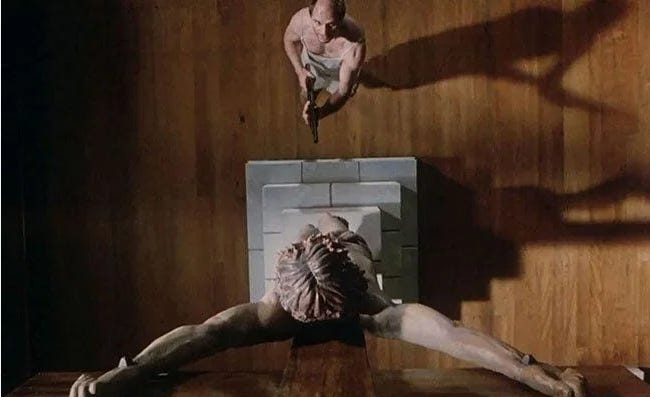
Film: The Quiet Earth
Director/Writer: Geoff Murphy/Bill Baer, Bruno Lawrence, and Sam Pillsbury
Have I Seen Anything Else by This Director and/or Writer: Yes, I suppose I have technically seen Murphy’s film Freejack. No to all the writers, though as an actor I did previously see Bruno Lawence in Roger Donaldson’s Smash Palace. If that counts for anything. I also haven’t read the Craig Harrison novel on which this film is based.
Speaking of films that remind you of other films as you watch them, I present to you Geoff Murphy’s intriguing 1985 New Zealand cult science fiction classic The Quiet Earth. In its opening moments (following a rather long sunset-based opening credits sequence, the music for which hit a particular noticeable swell when the “Music by John Charles” credit came up), with Zack Hobson (Bruno Lawrence) waking up naked in bed, to eventually dress and venture outside to discover what appears to be a completely unpopulated world, you can’t help but think of the opening to Danny Boyle’s 28 Days Later. A bit later, when Zack pushes his exploration of this new reality, he will discover that all sorts of quite intense and enormously loud things happened overnight that he apparently just slept through (this is actually explained later on). Among those things is the fact that apparently a commercial airliner crashed nearby, and the way Geoff Murphy and James Bartle’s tracking camera reveals the scope of this particular catastrophe sharply resembles a similar moment in Steven Spielberg’s 2005 masterpiece War of the Worlds. So this is potential evidence that this small scale but very good SF film possibly influence some rather big films down the line, but Murphy’s film wears its own influences on its sleeve.
The Quiet Earth really is a one-man show for a good stretch of time. In the dips in and out of depression and bouts of bizarre behavior are moments showing Zack seeing the very relative potential in his situation as the only person left on the planet. If you ever find yourself in similar circumstances, I would think the problem would not so much be that there’s nothing to do. I think there would be no end of things to do — and in these sequences I was strongly reminded of Romero’s Dawn of the Dead, though in a particularly Ouroborosian bit of influence, I suspect Zack Snyder’s Dawn of the Dead took a little something here and there — between drinking all the time, playing snooker, teaching yourself to drive a train, seeing how the other half lives by living in their houses, and very gradually going absolutely bugfuck insane; the problem would be the complete absence of anyone to do these things with. The benefit of telling this kind of story, at least for as long as the film spends telling it, is that you can get away with the kind of artificial quirkiness of behavior that often rankles me, because at any given moment like that in The Quiet Earth, I can’t help but think “Yeah, in his shoes, I’d probably get to that point eventually, too.” The problem is the more bugfuck Zack goes, the lazier his political satire gets.
But that doesn’t last very long, and after a while Zack bounces off the rock bottom he eventually hits, and lands on his feet. One thing I neglected to mention is that Zack’s job, before all this happened, had to do with some kind of secret project to set up an energy field around the Earth so that planes and other forms of air travel (probably space shuttles and the like) wouldn’t have to land to refuel. Seems like not much gain for what must have been a hell of a lot of work, especially when you consider the possibility that this whole thing may have vaporized everyone else on earth. Because that’s the other thing, except for one body at the plant where he used to work, there are no corpses. Being literally the only man for the job, Zack tries to figure out what happened. In so doing, he eventually meets another living person — almost all “last man on earth movies” have at least one other person, and this one will end up with two! — a young woman named Joanne (Alison Routledge). The two get over their initial trepidation and feel immense relief. And I found it interesting that Murphy takes the time to address the fact that upon meeting Joanne, a certain sexual energy will have sparked anew within Zack, but show him struggling — successfully, but struggling — to not let this unbelievable new life he’s found himself living turn him into some kind of creep.
Anyway, romantic entanglements do eventually enter into it, as they must, because they would, first between Zack and Joanne, and then when a third person a man named Api (Peter Smith) finds them. It was refreshing that The Quiet Earth broke the tradition, in films like this, to have warring factions of survivors. There’s really only the three of them, and once they’re able to get over their mutual suspicion, the three of them get along famously, if out of relief if nothing else. From here, the plot of the film heads in the direction of “Maybe we can reverse this.” As far as my ability to understand, and therefore retain, all of this stuff, all I can say is that they all seemed to know what they were talking about. There’s also a very interesting theory floated regarding why the three of them didn’t vanish along with everyone else, one that adds a mortal chill to what in other films would have been left as simply a noble climax.
* * * * *
This post is part of a series that is separate from, but related to, and will probably at certain points merge with, my Reading Project. For my details of what I guess is my Film Project, click here.
This: He’d cry at a bean commercial, if it was a sad bean commercial. Know the feeling but you nailed it. Once, while going through some severe chemo, I'd sit on the couch randomly crying over the the varied efforts of actors in tv commercials. Also, Delaney's Hogg brought to mind this title with a dastardly reputation by Scottish poet James Hogg: The Private Memoirs and Confessions of a Justified Sinner.