
The Fields We Know
On "Bullfighting" by Roddy Doyle, and "The King of Elfland's Daughter" by Lord Dunsany

I. I Don’t Give a Fuck About Anything Anymore
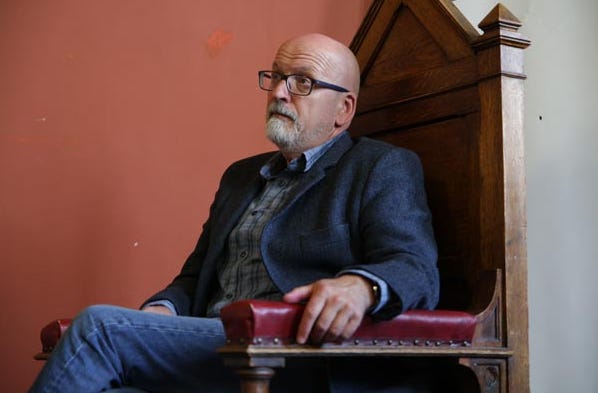
Author Previously Read: Roddy Doyle
Books Previously Read: The Commitments; The Snapper; The Van; Paddy Clarke Ha Ha Ha; The Woman Who Walked into Doors; A Star Called Henry; Smile; Love; a couple of short stories from The Deportees
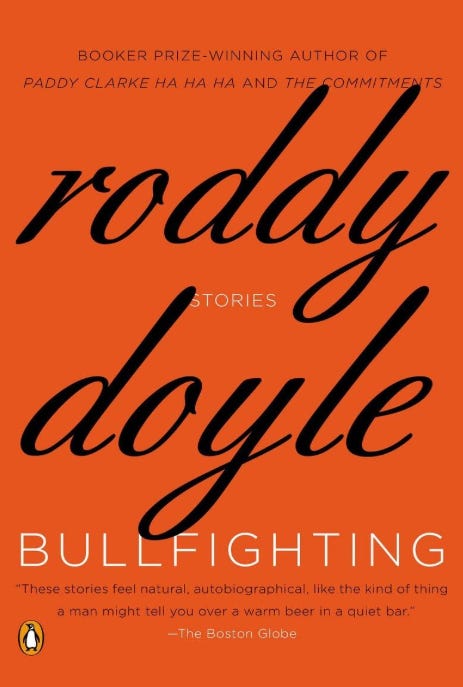
Book Read: Bullfighting
When Alan Parker’s film The Commitments came out in 1991, and I learned that it had been based on a novel, I wondered — please keep in mind I was a teenager, somehow stupider then than I am now — how a story so steeped in music, the sound of it, could work as prose. I doubt I thought in those terms, but whatever. I tracked the novel down, a slender little number by someone named Roddy Doyle. It was his first novel, and the first by him that I read. And as Doyle was now on my radar, I took special interest of his that was released post my awareness of him. That novel was Paddy Clarke Ha Ha Ha, his fourth novel, and the winner of the Booker Prize in 1993. I have a vague memory of reading the review of Paddy Clarke Ha Ha Ha in the Washington Post, and the critic writing that it was a novel to be treasured, but was so sad that one should not enter into it lightly. I won’t pretend that didn’t intrigue me, though my memory of that book is dim. I remember the two sequels to The Commitments better: The Snapper, which is about Jimmy Rabbitte, Jr.’s (he being the band manager in the earlier novel) teenage sister getting pregnant; and, my favorite of the three, The Van, which finds Jimmy Rabbitte, Sr. and his friend Bimbo operating a fish and chips food truck, as Ireland competes in the World Cup. That trilogy would be filled out many years later with The Guts, a novel I have thus far avoided as it deals with an older Jimmy Rabbitte, Jr. contracting bowel cancer. It might be funny, I don’t know. Anyway, that quartet, along with Paddy Clarke Ha Ha Ha comprise Doyle’s Barrytown Pentalogy (though I doubt he calls it that), that one not dealing with the Rabbitte family, but taking place in the same fictional Dublin suburb.
It is, I think, somewhat unusual for a writer of Doyle’s stature — winner of the Booker, shortlisted for it at least a few other times — to write so many books that are part of an ongoing series. That seems more like a genre thing, although I say that while being fully aware of the existence of John Updike (speaking of rabbits) and Philip Roth. I suppose it’s because Doyle has several of these (but so did Roth): not just the Barrytown/Rabbitte family novels, but also his trilogy about Paula Spencer — The Woman Who Walked into Doors, Paula Spencer, and, just two years ago, The Women Behind the Door; as well as another trilogy, collectively titled The Last Roundup. These novels — A Star Called Henry, Oh Play That Thing, and The Dead Republic, are an ambitious departure for Doyle (I did read the first one, but need to reread it). In his fiction, Doyle is mostly known for kitchen sink humorous dramas, or more accurately, sad comedies, but The Last Roundup has historical sweep to it, with the first novel covering the 1916 Easter Rising, and subsequent Irish Civil War. And if I didn’t have the self-imposed restriction on reading sequels, or books that are part of a series (Chandler’s The High Window, and detective novels like it, are exempt, for your information, because it’s not necessary to have read the Philip Marlowe novels that preceded The High Window to follow The High Window), and I was just reading Roddy Doyle because I was in the mood, I would be reading Paula Spencer. So thanks for nothing, you dicks.
With the exception of the third Paula Spencer novel, more recently Doyle has shifted to standalone novels, and the two I’ve read (there’s another standalone between those two, called Charlie Savage, which sounds a little bit too much like Doyle in “I shall now address some issues in modern society” mode, which is never a good sign, from anybody), Smile (2017) and Love (2020), while no great shakes in the title department, were both excellent, the former being darker and sadder than the title implies (although a title like Smile suggests an emotion in conflict with the word’s literal meaning), whereas the latter approaches the titular emotion through the friendship of two middle-aged men. That novel is especially moving.
Love is moving in a way that is very much in keeping with a drift in Doyle’s fiction that I have noticed, a very natural one, as Doyle himself approaches 70. While never a writer to look away from the everyday hardships of his characters, even when his primary goal was to amuse and celebrate the everyday facts of everyday people. But over the last several years, a melancholic and mortal fear, which has arguably always been just beneath the surface of his fiction, has floated to the top. I don’t know this for certain, but this seems to have first taken a strong hold of Doyle’s art with the publication of Bullfighting, in 2011. Doyle is a novelist first, and his short fiction collections, of which there are three, have had the whiff of gimmick about them. The stories in his first collection, The Deportees, were published serially, despite being short already, and were aimed at Ireland’s immigrant population. In 2021, his third collection, Life Without Children, stemmed from COVID, and the lockdown. There’s nothing wrong with any of this, but there’s a willed quality to those, as premises. One could describe Bullfighting similarly, because God knows themes repeat in these stories, but they read more like stories that Doyle needed to get off his chest, which I would say is how most good fiction comes into being.
In case I have given the mistaken impression that Doyle, overall, has become a ponderous writer, and Bullfighting in particular a ponderous book, let me tell you that nothing could be further from the truth. Rarely have I been so entertained when made to contemplate my own advancing age. No, for all its seriousness and sadness, Doyle’s fiction reads like a breeze. He’s like if Elmore Leonard wrote books in which nothing much happens. Not an entirely random comparison, as one of the things Doyle does extremely well is place his characters in the world in which we live, with references to pop culture that never come off as labored or silly or performative. About halfway through perhaps the best (and longest) story in Bullfighting, called “The Slave,” the narrator — a man named Terence who is so besotted with his own children that he’s sent into a near-heart attack-inducing panic at the appearance of a dead rat in his home, because what if his youngest, his baby, had woken up early and touched it and got sick? — is going through his various kids, and the reasons behind their names. One is named “Oskar,” from The Tin Drum. [His mother] wasn’t too keen on him being named after a dwarf but I persuaded her that if our lady got up to half the things that Oskar does in the book then we’d never be bored.” And the youngest?
And the little lady is Chili, after Chili Palmer in Get Shorty. He’s actually named after me, Terence, because we knew he’d more than likely be the last and she said we should name him after me and my father. I didn’t mind. I quite liked it, actually. Even though I’ve been reading books all my life and I’ve never come across a hero or even a baddie called Terence. But, anyway, we usually call him Chili. And that’s Chili in the book, not John Travolta in the film, good and all as he was.
I do appreciate that distinction. And perhaps you’re thinking it’s one thing to portray someone as pop culture savvy because that’s how most people are, and it’s another to portray that same person as someone who has read The Tin Drum. I would agree, those are two different things, but the latter isn’t an impossibility: you know both Saul Bellow and Martin Amis read both The Tin Drum and Get Shorty. (I have not read The Tin Drum.) And if that was it, there would be little point in bringing this up, but throughout the stories in Bullfighting Doyle’s characters bring up songs and television shows and movies, the kind of culture that nearly everyone in the Western world is familiar with, usually of the either low- or middlebrow varieties (I dislike those terms, but for the sake of expedience…), and does so without judgment. In that same story, Terence talks about a rift between him and his daughter:
I won’t let her watch Trainspotting. It’s a good film but she’s still too young. That was what I told her. Next year, probably. Which I thought was reasonable. It’s a good film, like I said. But there’s too much in it that’s not — okay, suitable. Unfortunately, that was the word I used. ‘Suitable.’ Her face, Jesus. It hurt. Maybe I’m just being stupid; I don’t know. She’s nearly seventeen. Anyway, that was when she informed me that my life was more than half over.
There’s no sneer in Doyle, and he understands that however far away from such things we may eventually drift, we all grew up on that kind of culture, and know it, sometimes by heart, and sometimes not entirely willingly. Doyle isn’t always interested in celebrating this stuff (though I think that’s his own genuine affection for Elmore Leonard coming through in the above passage), either. He simply understands and acknowledges it as a fact of life.
The bulk of these stories are taken up with aging, mortality, fatherhood, the subtle effects of unemployment in Ireland on marriages, and state of mind. One of the most interesting stories, “Ash,” deals with a man who one morning announces that she is leaving him. She gives no reason, assures him they’ll still be friends, but she’s leaving. Which she does, leaving not just her husband, but her young daughter. Yet she keeps returning, also without explanation, and usually, after the couple have sex, leaving again after just a day or two. At a loss on how to handle her absence, and intermittent but prolonged single fatherhood, an aimless conversation between Kevin, the husband and his divorced brother. Much of “Ash” is taken up with this, but its power and oddly hopeful effect, culminates with Ciara, the wife and mother, back home for a bit, with Kevin and Erica, their daughter, in the kitchen, watching TV:
They all sat in front of the telly and watched the Icelandic volcano erupting.
— Amazing.
They looked at the cloud as it grew and curled.
— It’s all ash, he told them.
— What’s ash?
Erica’s question — it was one of those brilliant moments. Kevin and Ciara looked at each other. They smiled. There were no coal fires in the house and neither of them had ever smoked. The cooker was electric. Nothing was ever burned. There was no real religion, at home or in school, so Erica had never noticed the grey thumbprints on Ash Wednesday, on the foreheads of the old and the Polish. A child like Erica could get this far without knowing what ash was, until she saw it spewing from a mountain.
So Erica’s parents explain ash to her, and it becomes a moment of shared parenting, and a re-bonding of the married couple. Again, no explanation is given for Ciara’s whiplash behavior. These things happen. Everything gets harder, the longer they go on. Even as a guy whose wife does not sporadically leave me for weeks on end, and who has no kids, I still somehow understood that moment, because of how specific — and unconsidered by me before this — the notion of a child growing up in an environment so modern that she’s not even aware of what ash is so specific as to somehow render it universal. Further proof, to me, who was already convinced of this theory, which is my own, were any needed that if an artist strives to achieve some kind of “universal” effect, than the best way to get there is by being as specific as possible.
In Bullfighting, at least — though it’s played a larger role in some of his novels — Doyle avoids the cliches and stereotypes involving the Irish and alcohol. One of the only times it seems like an issue for one of his characters is in the story “Teaching,” which is also one of the only times that he refers to the Catholic priest molestation scandal, which was bad in Boston, worse in Ireland. Otherwise, in these stories, Doyle, who is publicly no fan of the church, nevertheless respects that some people take great comfort, and do good things because of, their faith. The fact that the opposite of the latter is also frequently true does not negate the truth. And as I said, there is no sneer in Doyle. At least, not at the individual, who is just trying to get through it. In one of the collection’s toughest stories, “The Photograph,” the main character relates a history with his friends at the pub, and that recently, one of them, Noel, had died after fighting cancer. The ending of the story takes place at the funeral. There, the widow places a photo of her husband when he was young and healthy, on her husband’s casket:
It should have been heartbreaking. And it was. Seeing the faded colour, the big collar. He felt guilty. He’d let himself forget. He’d let the sick man become the man. He’d forgotten why Noel had been Noel, why they’d been friends. But there was more — the guilt didn’t settle. He could feel it, and hear. The gasp had become whispers. The photograph. Noel’s wife — Barbara — her putting the picture there, on the coffin, that was brilliant. And brave — going up there, letting the wood of the frame clatter against the coffin lid. Keeping her hands steady. She was even smiling when she came back and sat down.
Doyle doesn’t always leaven his thoughts on mortality with that kind of warmth. The other day, on social media, I posted the entirety of one of my favorite poems, “The Mower” by Philip Larkin. My post did some business, which led me to make one of my hilarious jokes, this one being that anyone seeking further inspiration from this Philip Larkin character would learn that his most famous poem is called “This Be the Verse,” and then they’ll read it and get mad at me. This brought someone else to bring up yet another Larkin poem, called “Aubade.” That poem is almost murderously existential. If you don’t know the poem, and you’re currently in a bad mood, skip it for now. You’d be better off reading Roth’s The Dying Animal1 on your birthday. Reading Doyle at his bleakest can feel a little bit like that. If you do know the poem, you probably think I’m exaggerating, and I suppose I am. “Aubade” is no fucking joke. But perhaps the darkest moment in Bullfighting comes in a moment called “Funerals.” No surprise, I know. But for much of it, it’s a strangely pleasant story about a man who gets into the habit of chauffeuring his parents to the many funerals they, at their advanced age, find themselves attending. Because it’s so common, there’s no gloom about it, and the trio will often stop for chips afterwards. This story, in fact, includes what is to me the book’s funniest line. Father and son, Bill, are discussing where they are, geographically, on their way to a funeral a bit farther distant than usual. The mother is very fond of the land they’re driving through, her husband less so:
They loved the new straight roads. They loved the fact that they didn’t have to go through places any more.
— If we could bypass the whole bloody country we’d be sorted.
— Ah now. It’s a lovely country.
— Only when you’re standing on it, love.
Bill laughed. His father didn’t. He groaned as he turned to look out the side window.
— Where are we now, Billy-boy?
— Past Bray, said Bill.
— Past Bray. That’s great.
— Bray isn’t the worst.
— That’s no compliment. The worst is unbelievable.
This is the tone of much of the story, but it ends, quite suddenly, on a note of such shattering emotional trauma that it would fit comfortably within a horror story. It’s a bit like Larkin at a shriek, rather than his usual quiet mumble.
Speaking of horror, I’d be remiss if I didn’t mention the strangest story in Bullfighting. It’s called blood, and it legitimately is a horror story (not his first; there’s one called “The Pram” in The Deportees, and another, called “The Child,” can be found in McSweeney’s Enchanted Chamber of Astonishing Stories). Not of the supernatural variety, but it’s called “Blood,” features a man with an overwhelming desire to drink blood, usually from packages of raw meat, all of which is quite gross, and all of which seems to have something to do with Roddy Doyle maybe having a hard time coming to terms with the fact that Dracula was written by an Irishman. I’m sure he’s fine with it, but Stoker does not go unmentioned. The story ends before the character graduates to what we might imagine to the next level of blood-drinking, and which in any even he confirms will be the case. And it ends on a very good line, very effective in its understatement, that is if you can excuse the fact that line is a reply to a question that I do not believe the character who asks it, or anyone in the world, would ask under those precise circumstances. I wish Doyle had found a smoother route there, but I’m mostly okay with it. You could arguably chalk the question up to the product of shock. If you read the story, you’ll see what I mean.
The other big theme in Bullfighting, and this bounces us back to Doyle’s treatment of popular culture, is the process of aging out of the culture. Of no longer knowing what the fuck young people are talking about. This is not brand new from Doyle, but he hits it pretty heavily in these stories. Some of his characters are fine with the natural way of things, for others it just makes them think of death more (I’m out of the culture, aggressively so, at least as far caring about staying up on things go, and I’m happier that way; it may be the one thing that doesn’t make me think about death). As usual with Doyle, there’s humor to be mined from this. In the title story, two friends are discussing a cocaine crisis that has been sweeping through their area. It is of course centered largely among young people, and the two friends naturally ask each other about their children. One says: “— I’ve been watching my girls since it got into the news. And they’re the same as they’ve ever been. So they either aren’t using cocaine or they’ve always been using cocaine.”
I think the best way to give you an idea of the overall effect of Bullfighting is to quote another ending at you. In the story “Animals” (not a fiend for titles, is Doyle), a father confesses to his adult son that their childhood dog, which had been run over, had not been run over by some stranger’s car, but, quite accidentally, by George, the father, a fact which he hid from his children because of how much worse the dog’s death would be for them if they knew. But keeping it from them has haunted him equally, so he confesses. The son, Ben, asks:
— Why now?
— Why tell you?
— Yeah.
— I don’t know. I was just thinking about it — I don’t know.
— It doesn’t matter.
— I know, says George. — But it would have, then. When you were all small.
— No, says Ben. — It would’ve been alright.
— Do you reckon?
Ben looks down the bar.
— Listen, he says. — We all knew he had a great da.
George can’t say anything.
His heart is too big for him, like the dog’s brain. The blood’s rushing up to his eyes and his mouth. Him and the dog, they’ll both explode together.
As images of hopeful uplift go, that’s a weird one.
II. He Looked Around and Saw No Familiar Thing
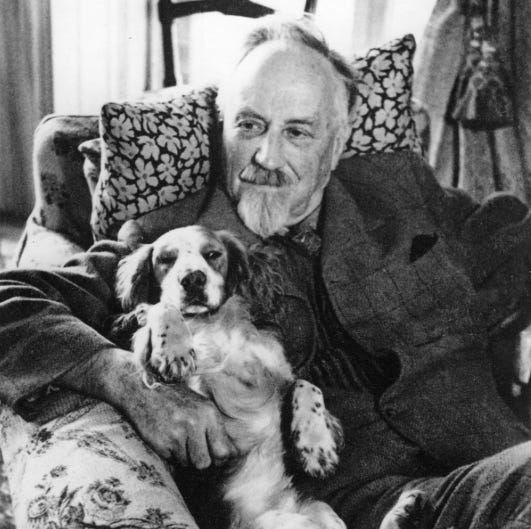
Author Never Read: Lord Dunsany
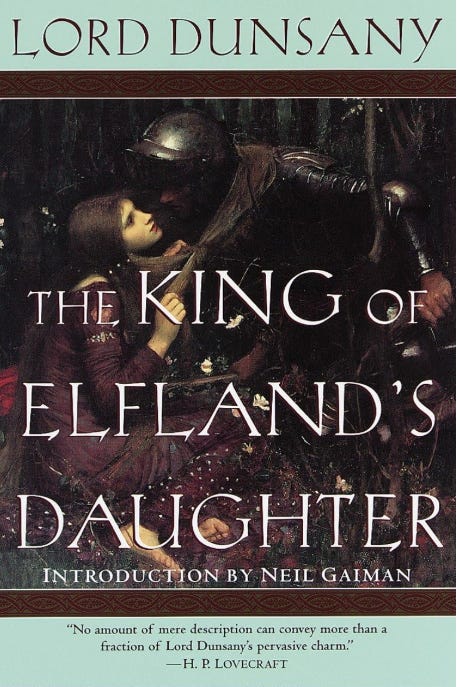
Book Read: The King of Elfland’s Daughter
I like to think of myself as a friend to all genres. Not merely to all genres, but a friend as well to each genres various subgenres. I think by and large, readers, whether or not they keep reading into adulthood, get into it via some variety of genre fiction. I certainly did, my route going through crime and horror fiction, which some significant detours into science fiction. But truthfully, excepting a few strong affinities (Harlan Ellison, Theodore Sturgeon, Robert Silverberg, probably others), I would count SF as one of my primary touchstones (well, Ellison is) as a reader. More neglected still is a genre often associated with science fiction, fantasy.
Unless you count some dark fantasy, the kind that verges so far into horror that it becomes horror, a lot of it from the Richard Matheson school of this sort of thing, my experience of the fantasy genre must be counted as meager at best. I’ve read The Hobbit. Twice, in The Fellowship of the Ring, I’ve made it to the Council of Elrond before it all got to be too much, both times. I’ve read Game of Thrones and A Clash of Kings, but I never finished A Storm of Swords, though I made it well past the halfway mark; I believe at the time I got distracted from it because we were moving. But that’s the book where all the crazy shit happens, most of which I did get to, and it’s my theory that the reason Martin is now stuck is because he already did all the cool stuff in that book. I’ve read a little, a very little, Robert E. Howard. I’ve read a little more by Michael Moorcock. I’ve read In Yana, the Touch of Undying by Michael Shea. I could probably go on, but not for too much longer.
So when the opportunity to read one of the key novels in this genre, at least as the genre persisted in the 20th century, and continues to persist in the 21st, a genre I have shamefully turned my back on, was practically forced upon me, I decided, “Okay.” That book, The King of Elfland’s Daughter, by Edward John Moreton Drax Plunkett, the 18th Baron Dunsany, aka Lord Dunsany, was first published in 1924. It has gone on to inspire pretty much everyone with even a glancing connection to the genre, everyone from William Butler Yeats to H. P. Lovecraft. Dunsany wrote a lot, novels, plays, short fiction, both in fantasy and out of it, though in a curious way he was particularly suited to that, or any fantastical genre, given the period in which he lived. Dunsany was born in 1878, and died in 1957. Living through that much history, that much change and upending and conflagratioin and rickety rebirth must be overwhelming in the moment. In such circumstances, I can imagine one’s thoughts turning to fancy. Such thoughts could lead to frivolity and escapism, or they may not.
The Kind of Elfland’s Daughter was Dunsany’s second novel, but it came after years of publishing short fantasy fiction (he published his first story collection in 1905). This perhaps explains why such an early novel reads at times like Dunsany reckoning with his life’s work, or the genre he’s been devoted to.
The story is deceptive in its simplicity, though the reader could be tipped off that this won’t be a standard damsel-saving kind of story by the strange way it kicks off. First, there are essentially two locals: one, Erl, is a kingdom within our world of Earth, and earthly concerns. Erl shares a border with the titular Elfland, which as you might imagine is a land of wonder and magic unknown to man, as the crossing of that party by either side could cause troubles. But one day, in Erl, a group known as the Parliament of Erl, comprised of a group of farmers and businessmen who claim to represent the will of the people, go to their lord and strongly request that the lord do something to bring magic into Erl. This would make Erl a land of note, word of its fresh magical wonders spreading, so the Parliament insists, far and wide, making Erl both a place of history and of legend. The lord, believing that the Parliament does indeed speak for the people (this is left a little ambiguous, but I’m leaning towards they don’t actually), and wishing to do the people’s bidding, sends his son Alveric to Elfland, and to entice the king’s daughter, Lirazel, to marry him, and bring her back to Erl, which would in effect — because Lirazel’s very person radiates the stuff, affecting everything around her — bring magic to Erl.
Alveric accepts the job, and a sword from his father, though he knows that such earthly weapons would be useless in Elfland. Therefore, he visits the old witch, named Ziroonderel. Alveric wins this witch’s undying devotion:
And alone would roam this witch at certain tides of Spring, taking the form of a young girl in her beauty, singing among tall flowers in gardens of Erl. She would go at the hour when hawk-moths first pass from Bell to bell. And of those few that had seen her was this son of the Lord of Erl. And though it was calamity to love her, though it rapt men’s thoughts away from all things true, yet the beauty of the form that was not hers had lured him to gaze at her with deep young eyes, till — whether flattery or pity moved her, who knows that is mortal? — she spared him whom her arts might well have destroyed and, changing instantly in that garden there, showed him the rightful form of a deadly witch. And even then his eyes did not at once forsake her, and in the moments that his glance still lingered upon that withered shape that haunted the hollyhocks he had her gratitude that may not be bought, nor won by an charms that Christians know.
This leads Ziroonderel to fashion for Alveric a sword made of thunderbolts, and therefore more effective in Elfland.
Alveric crosses the border, finding the woods of Elfland ride with strange creatures and grasping trees, which he fights back with his magic sword. Eventually he makes it to the grounds of the king’s castle, and sees her.
She walked dazzling to the lawns without seeing Alveric. Her feet brushed through the dew and the heavy air and gently pressed for an instant the emerald grass, which bent and rose, as our harebells when blue butterflies light and leave them, roaming care-free along the hills of chalk.
…
She wore a crown that seemed to be carved of great pale sapphires; she shone on those lawns and gardens like a dawn coming unaware, out of long night, on some planet nearer than us to the sun. And as she passed near Alveric she suddenly turned her head; and her eyes opened in a little wonder. She had never before seen a man from the fields we know.
Similar to our story getting started through what could be described as an attempt to increase tourism, Lord Dunsany increases the strangeness by denying what a reader might expect to happen from this encounter. It’s not that Alveric fails to woo Lirazel. It’s just that he does it by slaughtering the guards who leap to her aid when they see a strange man approaching her on castle grounds. These guards have done nothing wrong, yet Alveric cuts the all down. And there’s something very much not of Elfland about Alveric as a figure and in his actions, and this draws Lirazel almost wordlessly along with him.
Apart from the absence of any magic Erl, the starkest difference for Lirazel to become accustomed to is the way time works in our world. In our world, time works as you and I understand it to. In Elfland, there is no time. Like an Earth astronaut returning from some spectacularly distant planet, having aged a year, while all his loved ones, including the youngest, have faded and died years ago, when Alveric returns home from Elfland, his father has withered away, and time has jumped years and years ahead. One example of the curious ambivalence I detected throughout The King of Elfland’s Daughter comes with how Dunsany handles the idea of mortality between the two worlds. As described, Lirazel seems to not understand death, to have no concept of aging or dying. Late in the novel, two characters — one a human from our world, the other a troll from Elfland — meet for the second time. One, Orion, is the son of Alveric and Lirazel. Anyway, the troll asks a question:
“How many years have gone over you,” asked the troll, “since we spoke in Erl?”
“Years?” said Orion.
“A hundred?” guessed the troll.
“Nearly twelve,” said Orion. “And you?”
“It is still to-day,” said the troll.
Yet with that in mind, the killing of those Elfland guards did not seem to shock Lirazel in the fact of it — the fact of death among the otherwise seemingly immortal — but only that such an action was carried out. There’s an ambivalence about death, or in how it’s dealt out. Tainting Elfland with the facts of mortality is the primary reason he wishes to keep his daughter away from Erl, and the reason he maintains his three defensive runes, magical spells that can repel the effects of encroachment of Erl onto Elfland. Though once cast they cannot be cast again. These two ideas converge when Lirazel becomes disenchanted with Erl, as the wonder she feels at the presence of stars — day does not fade into night in Elfland — and her desire to pray to them as holy objects is met with an angry rebuke from Alveric. Alveric, and the rest of Erl belong to a religion that I suppose is somewhat Christian-esque, but in any case is represented by a holy figure known as the Freer. The Freer objects to the encroachment of magic onto Erl as much as the king of Elfland kicks back at the opposite. Anyway, Lirazel’s deep unhappiness is felt by her father, their magic being so strong, so that he casts two runes: one to pull the border of Elfland farther and farther away from Erl, so that when the effect of the second rune — which is to simply bring Lirazel back to Elfland — is to lead Alveric to fruitlessly seek the border of Elfland, so that he may cross it and bring his wife back, we find this character, our initial heroic(?) protagonist, left for the rest of the novel wandering for over a decade, trying to find the border.
A not insignificant portion of the novel is given over to this pointless and failed search, which does nothing for Alveric and his two remaining allies but drive them mad. Earlier in Alveric’s quest, he questions the humans on our side of the border about what lies to the east. The east is where Elfland is located. But none of the people act like they even know there is such a direction as “east.” Elsewhere Dunsany describes such people never even looking into that direction. The reason for this, we come to learn, is that they fear becoming enchanted, they fear being overwhelmed by the magic that could be available to them, and distracting them from the business of life. One man is described this way:
And Vand enquired of them if they had found Elfland. But he spoke as one asks of children if their toy boat has been to the Happy Isles. He had had for many years to do with sheep, and had come to know their needs and their price, and the need men have of them; and these things had risen imperceptibly up all around his imagination, and were at last a wall over which he saw no further. When he was young, yes once, he had sought for Elfland; but now, why now he was older; such things were for the young.
Which reads to me as a clear invitation to embrace fantasy, or at least to see the fantastical in our world, the one we know. However, at the same time, the wonders of Elfland are described in glorious detail, and while there are hints in Dunsany’s descriptions of butterflies and things like that, of the wonders of reality, Dunsany does also highlight the drudgery of reality. It’s a little bit like Werner Herzog’s distinction between “the accountant’s truth” and “the poet’s truth,” and which is more valuable, as art.
Similarly, Dunsany describes the dangers reality can have on fantasy. This is where the ambivalence really jumps up. There are two Elfland creatures that regularly cross the border, for mischief or just casually: trolls and unicorns. Unicorns become a key figure when Orion, named for the hunter by his star-besotted mother, learns to hunt, and seeks to hunt unicorns. Unicorns, we learn, are hated by the Elfland marsh people, and when a job arises to help hunt unicorns, one Elfland race agrees to betray another. More than that, though, is this passage, when Orion kills his first unicorn. This is before we learn that the marsh people find unicorns “haughty,” and I should probably at this point mention that we never see any unicorn being a dick to anybody. So Orion and his dogs have the unicorn penned in. The dogs are prepared to take it down, and Orion is prepared to fire an arrow, before deciding that no, that’s unfair to the unicorn, to just shoot it. It’s more fair, he thinks, to let the dogs take it. More fair, but hardly more kind:
That graceful bowing neck, with its white arch of hard muscle driving the deadly horn, was wearying Orion’s arm. Once more he thrust and failed; he saw the unicorn’s eye flash wickedly in the starlight, he saw all white before him the fearful arch of its neck, he knew he could turn aside its heavy blows no more; and then a hound got a grip in front of the right shoulder. No moments passed before many another hound leaped on to the unicorn, each with a chosen grip, for all that they looked like a rabble rolling and heaving by chance. Orion thrust no more, for many hounds all at once were between him and his enemy’s throat. Awful groans came from the unicorn, such sounds as are not heard in the fields we know; and then there was no sound but the deep growl of the hounds that roared over the wonderful carcase as they wallowed in fabulous blood.
Coming in a fantasy novel that is not filled with epic battles, this wild flash of violence, and the visceral frenzy of it, is a jolt. And around this time, I did begin to wonder if a big battle was possibly where we were heading, a kind of Bakshi-esque clash between the magical and the manmade. That the streets of Erl would run red with unicorn blood. It’s a nasty way for Dunsany to force the reader to consider reality fantasy as separate but related, and each can damage or destroy the other. Because while no, there is no battle, what does happen is a kind of capitulation by one side, the result of which overwhelms the other side, and a bunch of people who thought they were going to get what they wanted did get it only to find out they didn’t really want it.
I may be making too much of the ambivalence I sense in The King of Elfland’s Daughter. There’s quite a bit of (somewhat eye-rolling, it must be said) “It’s a fool who lets the joys of childhood fade away!” (I’m paraphrasing) dialogue towards the end, but I can’t help but think about how unicorns are treated by both sides. And I’m sorry, but the phrase, buttered in the final pages, “Elfland is coming” sounds only ominous. There’s nothing bright about that phrase.
* * * * *
This post is the latest in what will turn out to be a very long series of essays about my year of reading, from 2025 to apparently the end of time. For more details about this project, please read this post.
Yes, yes, that novel is the third in Roth’s Kepesh trilogy of adventures.
I've yet to tackle the Dunsany half of this piece, but in answer to Larkin's "Abaude", there's this:
Paraphrasing Albert Brooks in "Real Life"-- Seventy percent of life is spent staring at walls.