
You're Going to Break It
On Arnaud Desplechin's "Esther Kahn" and Joseph Losey's "Eva"

I. Her Eyes Were On It
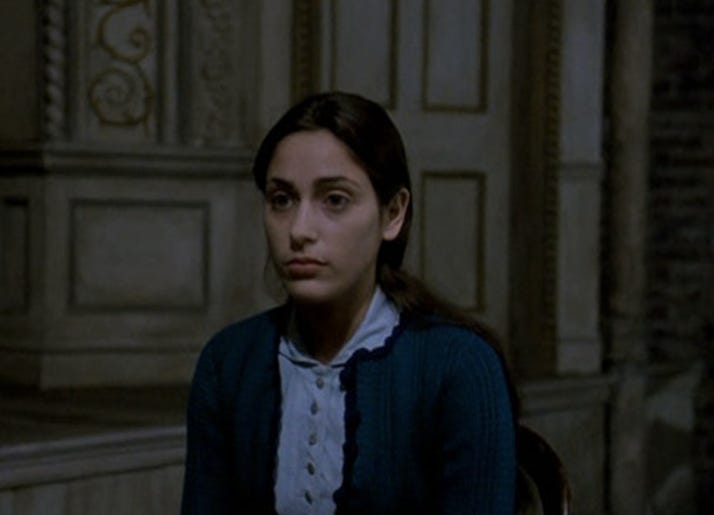
Film: Esther Kahn
Writer/Director: Arnaud Desplechin/Desplechin and Emmanuel Bourdieu
Have I Seen Anything Else by This Director and/or Writer: No
Not that you’re interested, or should care, but I own two Arnaud Desplechin films, and the one I’ve been circling, and have owned, the longest is not the one I watched for today. That film is La Sentinelle, and it’s a thriller, so I don’t know what I was thinking in choosing Esther Kahn (2000), a film set in Victorian London about a young Jewish actress over it. Actually, I know what I was thinking: Victorian London, and this movie co-stars Ian Holm. That’s more than enough for me.
Narratively, this film is simple. Esther (Summer Phoenix) lives with her large family, her parents and many siblings, all of whom work in a garment factory — and, this being a Victorian London garment factory, the conditions are poor. But they work hard, and seem, most of them, in the early stretches of the film, to be in mostly good spirits. Except for Esther, who not only is constitutionally withdrawn and moody, and who does not work hard at all. She becomes obsessed with the theater, where she goes frequently with her brothers and sisters. One such trip leaves her angry, because she was so put off by the lead actress’s performance. She argues, quite seriously, though her siblings both disagree and are uncertain where this passion is coming from, that this actress kept making mistakes, and that the performance she should have given would have been “so easy.”
There are several interesting things about Esther that the viewer learns early on, much of it through the narration delivered by Ramin Grey. When she’s seated in the theater to watch the play, which from what we can tell appears to be some sort of broad Yiddish comedy, she becomes rapt not by the story so much as just that this display of humanity is happening in front of her. Esther seems to associate stage acting with humanity more than she does the actual, non-performance humanity that exists in her home and in the community where she lives. In reality, actual life as its lived, she has at most a “disinterested curiosity.” At one point, she tells another character who has become frustrated with her detachment, that she watches everyone else like they’re sailing down a river, and she’s watching from the shore. She says this with some anger, a real frustration about the way her mind works, and the way her emotions don’t.
Inevitably, she’s drawn to becoming an actress herself. After some jobs as an understudy, and during one such gig, on a production of The Merchant of Venice, she comes into contact with Nathan Quellen (Holm), an actor whose career appears to be in some sort of free fall, but who has much wisdom to impart to Esther. Holm is in the film less than I thought he’d be, but the scenes between him and Phoenix are the best in the movie. What struck me most was how reasonable, logical, and philosophically acute much of what Nathan had to say. At one point, he cautions against any kind of purely technical, consciously performative acting. This, he says, is a lie, and “audiences don’t come to the theater to be lied to.” At the same time, he goes on to add, if an actor strives only for a kind of kitchen sink truth, then the audience is left with nothing to believe in. In other words, the artifice, which is to say the artistry, of performance must still be present. Later, he praised Esther’s progress after an acting exercise, saying that she’s managed to “forget the meaning.” Because of course, the character would know nothing about whatever Greater Meaning the playwright has put into the words the actor is speaking, nor should the actor perform as if they do. This is perhaps just a fancier way of underlining the importance of “being in the moment,” but to “forget the meaning” seems to me, someone who’s never acted, to be more to the point.
Another thing I found interesting about how Desplechin approaches the problem of depicting acting in a film starring actors who are actors. He basically never shows anybody acting. You see a little, though its mostly during rehearsals, where the actors — the characters who are actors, I mean — wouldn’t be expected to pour their heart and soul into a performance. You don’t even see the acting exercise I referred to above. A different acting exercise that Nathan has Esther do is laid out in great detail, before the film cuts and we never see her try it. I think several things are achieved in this way. The most practical thing about it is that however “realistic” we in the audience might find a given film performance, however believable and natural and whatever else we might call it, if we were in an elevator with a person behaving with the same level physically and emotional expressiveness that the actor who gave that naturalistic performance, we’d probably get off before we reached our floor. Acting is heightened behavior, almost by definition. In movies where an actor character is shown acting, it’s never on the same register as the performance of that actor — the actor playing the role, I mean — when they’re not on stage or in front of a camera , and shouldn’t be. One example that springs to mind is the clips of the films Jake Gyllenhaal’s doppelganger in Denis Villeneuve’s Enemy appears in — in that case, I thought the lily was being gilded a bit. There are exceptions to this — Naomi Watts’s audition scene in Mulholland Dr. arguably being one — but generally this kind of, frequently accidental, probably, metafictional element can be jarring. Desplechin avoids that by simply stepping around it. The other thing this does is keep Esther’s talent mysterious. What little professional, in front of an audience acting we see from her comes during the climactic, and chaotic, production of Hedda Gabler, and even then we see very little from her. Any big scenes we see her performing are obscured by Grey’s voice over narration.
And it’s important for her talent to be mysterious. The core to Esther’s story is her natural state of emotional remove. Nathan asks her if she’s ever had sex, and when she says she hasn’t, he goes on to tell her that her life must be lived, experience must be gained, if she ever hopes to reach the height of her gifts that he’s positive she’s capable of. Esther is, in effect, a sociopath, but one who goes about seeking a cure. To do so, she, somewhat mercinarily, hunts up a boyfriend, in the form of a snooty French drama critic (but I repeat myself) named Philippe Haygard (Fabrice Desplechin, the director’s brother). In the early goings of this relationship, though Haygard seems at first a good fit, as he’s enthusiastic about her talent and wants to help her succeed, the audience should be able to see trouble brewing because it’s very clear that the only reason she is doing any of this is to gain “experience.” I’m not really sure going about life in this manner is the same thing as gaining experience. It’s very clinical, in any case, and distinctly passionless.
Yet the life experience Esther seeks is ultimately found, and it comes very close to ruining her. Mentally, Esther is clearly quite unwell, and to have her first genuine emotional response to life lived as a human being is the crushing pain of heartbreak can make someone such as her wonder what the point of living that kind of life could possibly be. Better to be blank all the time, to be apart from the rest of mankind. If she didn’t have acting, if she didn’t have an outlet for the misery of experience, then I shudder to think what might have become of her.
My big question, coming out of this, is why Summer Phoenix hasn’t had a better career, because she’s remarkable in this.
II. Bloody Welshman
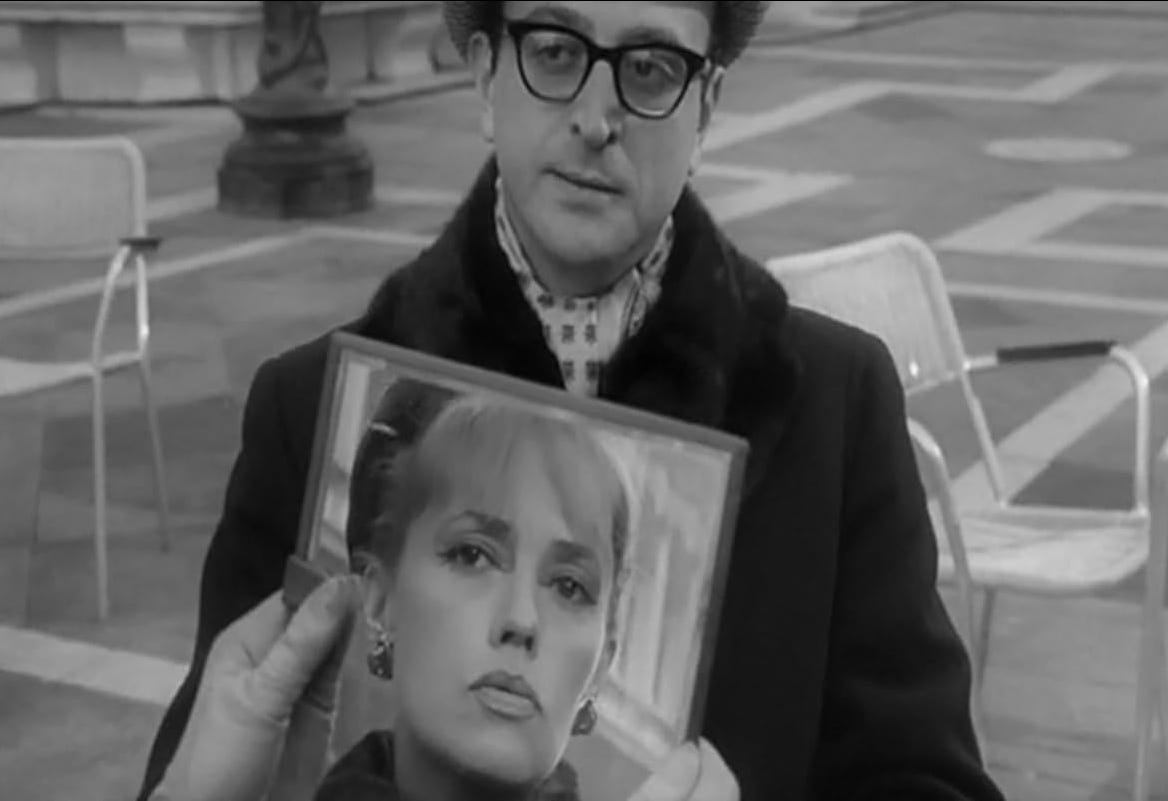
Film: Eva
Writer/Director: Joseph Losey/Hugo Butler and Evan Jones
Have I Seen Anything Else by This Director and/or Writer: Losey, sure have: The Boy with Green Hair; M; The Prowler; Time Without Pity; Blind Date; The Damned; Accident; Figures in Landscape; Mr. Klein. Butler, yes, he co-wrote Buñuel’s The Adventures of Robinson Crusoe. Jones also yes, as he wrote The Damned and Wake in Fright
Given how taken I was with Esther Kahn, it was disappointing to learn that it had been taken away from Desplechin, and about 15 minutes or so were cut from it against his wishes. His preferred cut isn’t available, from what I could find, and is only rarely screened. As a film lover, or anyway an occasional one, I should be used to that sort of thing by now, and in fact I am, as I went into Joseph Losey’s 1962 film Eva with my eyes wide open. I knew this film was a compromised production, such that it left Losey somewhat bitter and disillusioned — this coming after he’d already been blacklisted due to HUAC and McCarthy and all that, and had been exiled to Europe. In his biography of the director, Joseph Losey: A Revenge on Life, writer David Caute quotes Losey’s own feelings about Eva, after seeing the producer’s cut, which had severely whittled down Losey’s vision (about an hour of his version was cut out, a run-time which even Caute describes as “self-defeating” and “self-indulgent”'; self-defeating it may have been, but I refuse to accept “self-indulgent” as a criticism of art):
Losey saw this version, distributed by Gala in Britain, on 23 April 1963 and called it ‘a common, tawdry, little melodrama — unclear, pretentious, without rhythm and taste…’
Well I liked it. You’d think, under the circumstances I’ve just laid out, that Eva would play as some kind of style and personality free bit of European tedium. But it’s not that, and in fact if you’re at all a follower of Losey’s work, Eva seems to chronologically fit exactly where it can be found, in that span of films he made in the 50s and 60s, which also includes Blind Date, and has that same loose, yet rhythmic pace and aura, as though a jazz record had been the guiding principle in the editing room. And indeed, a desired Miles Davis score fell through, and the alarmingly large number of Billie Holiday songs Losey wanted to use (over 20) was pared down to three.
Similar to Esther Kahn, and for this I am grateful, the plot of Eva is simple. And before going into that, I’d like to say my excitement increased when I learned the film was based on a novel by James Hadley Chase. I’ve only read Chase’s No Orchids for Miss Blandish, but that book is crazy enough that I thought Eva might entertainingly go off the rails, narratively-speaking, but it’s fairly controlled in that sense. Anyway, we meet Tyvian Jones (Stanley Baker), first some years after the events of the film took place. Both distraught and distracted, in a pub a man angrily reminds Jones that the reason they’ve all gathered is for a remembrance of something horrible that happened. And soon we’ve flashed back, and we’re in Venice, at the Venice Film Festival, where a film based on a novel Tyvian Jones wrote has just won top prize. His future looks bright, the director the film, Sergio Branco Mallone (Giorgio Albertazzi) is eager to work with Jones again, if only Jones would write another book, and Sergio’s beautiful assistant, Francesca (Virna Lisi) is smitten with Jones — to Sergio’s, it must be sad, rather gentlemanly chagrin — and the two of them are about to be married. Her job, however, takes her away from Jones’s side for long periods. When he returns home, he finds that his home has been overtaken by an acquaintance of his named Pieri (Checco Rissone), and a call girl named Eva (Jeanne Moreau). Pieri is rather easily dispensed with, and Jones, naturally, becomes enamored with Eva, and pursues her. Jones does this guiltlessly, and one of the features of this film is how much of a worthless prick Tyvian Jones turns out to be.
A lot of what transpires over the course of the film is Jones becoming more and more dissolute. He drinks more and more, eagerly cheats on his fiancée, though it must be said much of this is done joylessly. Eva, who to some degree goes along with Jones’s desires, certainly doesn’t encourage him to enjoy himself more. Though this is putting things perhaps a bit too simply, Eva seems to despise Jones, as a kind of hobby. She certainly doesn’t care about him, and Jones, for himself, doesn’t really seem to care about anyone. Does he care about Eva? He wants her. That’s not really the same thing, or not necessarily the same thing. There is evidence that he cares about Francesca, but as his affair with Eva has been carelessly public, she learns of it, as does everyone else, and confronts him. During the ensuing argument, all Jones can offer up by way of a defense is to point out that he loves all women, he’s that kind of guy, and that’s just how it is. Well, okay. The depths of Jones’s selfish pointlessness as a human being only gets worse, and he’s left, by the end, where he deserves to be left.
The film I was reminded of the most while watching Eva was Otto Preminger’s Bonjour Tristesse (1958). That film presents as a comfortable film with a sunny disposition, one that belied its rotten heart. Things go bad in that film in a way similar to the way things go bad in Eva, though in Bonjour Tristesse that turn comes as a surprise. The difference is that from the start Eva is far icier, much starker — it has no mask of pleasantry to remove. You know where you’re heading the moment you step on the boat. I will say that the fate of one character is rather clumsily handled, cinematically. I don’t know if this was the result of the producer’s cutting something, and it’s not as though you can’t figure out what happened, but the drama, the shock, is heavily diluted by the way it’s shot. Try telling that to Tyvian, though. That would cut no idea with him.
* * * * *
This post is part of a series that is separate from, but related to, and will probably at certain points merge with, my Reading Project. For my details of what I guess is my Film Project, click here.
I really need to see "Esther Kahn." Desplechin's "Kings and Queen" is an all-time favorite of mine, and his "A Christmas Tale" isn't far behind. (I periodically hold out hope that Criterion or someone like it will release a remastered version of his amazingly-titled "My Sex Life... or How I Got into an Argument." I own a DVD of it, and it was, shall we say, not mastered very well.)